Speech recognition now turns a clear podcast into a usable transcript in minutes, for almost nothing. That has hollowed out the easy end of transcription work. Clean, single-speaker audio is mostly handled by machines, and platforms that still pay humans for it pay less than they used to.
The work has not disappeared; it has moved. People are still paid to fix machine drafts, to handle audio that machines get wrong, and to work in fields where an error has consequences: legal proceedings, medical records, research interviews and accessible captions. This guide covers what is left for humans, the specialist niches, the quality control clients expect, and the number that matters most: pay per audio minute compared with pay per hour actually worked. Rates were checked on platforms’ own pages in November 2026.
| At a glance | |
|---|---|
| Startup cost (estimate) | Low: a computer, good headphones, optionally a foot pedal and paid software |
| Time to first payment (estimate) | Days to weeks once accepted; some platforms have waitlists |
| Skills needed | Fast, accurate typing, excellent grammar and spelling, careful listening, research skills |
| Where customers come from | Transcription platforms, agencies, direct clients in research, legal and media |
| Biggest catch | Pay is per audio minute, so difficult audio can push your hourly earnings very low |
How AI changed the work
Most human transcription work today is one of three things:
- Editing machine drafts. An automatic transcript comes first; a human corrects names, technical terms, speaker labels and mistakes. It is faster than typing from scratch, and usually paid less per minute.
- Difficult audio. Several people talking over each other, strong accents, background noise, poor phone lines and specialized vocabulary still trip up machines.
- High-stakes accuracy. Legal, medical and research clients often need a person accountable for the final text, and specific formats machines do not produce reliably.
If you are starting now, plan to work with AI tools, not against them, and aim for a niche where accuracy is paid for.
Specialist niches that still pay
Legal transcription. Depositions, hearings, interviews and police recordings, often with strict formatting and verbatim rules. Rev, for example, lists legal transcription pay of $0.55 to $2.00 or more per audio minute, compared with $0.40 to $1.10 for general transcription, according to its freelancer page. Court reporting itself is a separate, certified profession in many places.
Medical transcription and documentation. Physicians’ notes and reports require knowledge of medical terminology and privacy rules. Much of this work now involves editing speech recognition output, and it typically requires training or certification. The field has been shrinking as hospitals adopt automated documentation, so research local demand before investing in a course.
Academic and market research. Qualitative researchers interview people and need accurate, confidential transcripts, often with timestamps and speaker labels. Universities, research agencies and doctoral students hire directly.
Captioning and subtitles. Video needs time-synced captions for accessibility and reach. Rev lists captioner pay of $0.54 to $1.10 per audio or video minute, and subtitle translation from English into other languages at $1.70 to $4.00 or more per minute, depending on the language.
Foreign-language transcription. If you are fluent in another language, transcription and translation in that language face less competition than English work.
Quality control: what clients expect
Accuracy is the product. Professional transcripts follow a few standards:
- Style guides. Each client or platform has rules for formatting, speaker labels, numbers and tags. Learn them before your first file.
- Verbatim or clean verbatim. Full verbatim keeps every “um”, false start and stutter (common in legal work). Clean verbatim removes them for readability (common in business and media work). Ask which one before you start.
- Timestamps at set intervals or speaker changes, if requested.
- Research. Look up names, places, companies and technical terms rather than guessing, and mark anything you cannot hear with the client’s tag for inaudible speech.
- A final proofreading pass against the audio, usually at higher playback speed, to catch errors.
Platforms review your work and score it; low scores mean fewer or lower-paid jobs, or removal.
Pay per audio minute vs per hour actually worked
Almost all transcription is paid per minute of audio, not per hour of your time. That is the number to understand before you start.
For clean audio, an experienced transcriptionist might need around three to four hours of work per hour of audio; beginners and difficult files take much longer. Editing a good machine draft is faster, but rates for editing are usually lower.
A simple example: a 60-minute file at $0.60 per audio minute pays $36. If it takes four hours, that is $9 per hour before taxes. If the audio is difficult and takes six hours, it is $6 per hour. The same file at a legal rate of $1.50 per minute pays $90, or $22.50 per hour for four hours.
So: track your actual time per audio minute for every job, choose files you can do efficiently, and move toward niches and direct clients that pay more per minute.
Getting work
- Transcription platforms. Rev, for example, pays weekly via PayPal, with applications that include a skills assessment and a sample transcript, and it notes a waitlist due to high application volume. Other platforms work similarly; read reviews from current transcriptionists about pay and job availability.
- Freelance marketplaces. Upwork and Fiverr have transcription jobs, often from researchers and podcasters, at varied rates.
- Direct clients. Researchers, law firms, journalists, podcast producers and event organizers. A short page with your niche, turnaround time, confidentiality practices and rates per audio minute helps.
- Agencies that specialize in legal or medical work, which often require experience and testing.
Tools and setup
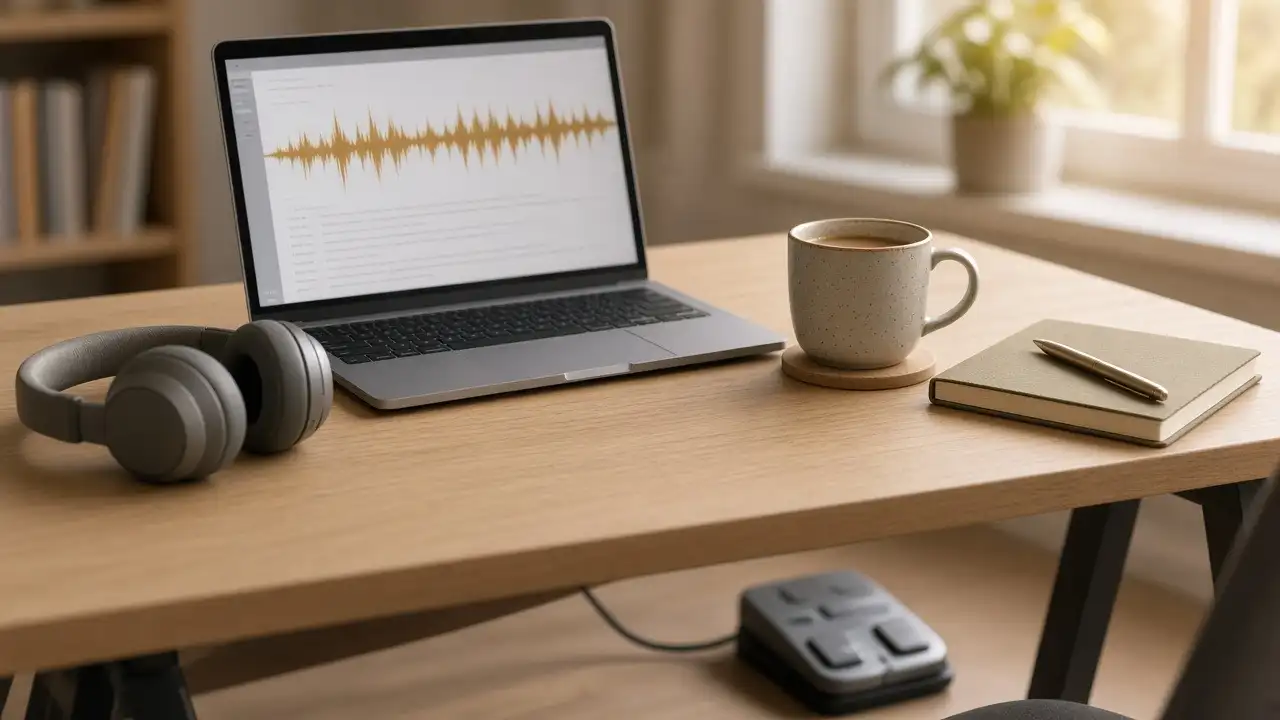
- Headphones: good closed-back headphones make a large difference on hard audio.
- Software: a transcription player with keyboard shortcuts for pause, rewind and speed control; many are free.
- Foot pedal: optional, but lets you control playback without leaving the keyboard.
- Text expanders: shortcuts for common words, names and tags save time on every file.
- AI transcription tools to create first drafts for your own direct clients, if the client permits it. Check confidentiality terms first: some clients forbid uploading their audio to third-party services.
Confidentiality
You will hear private things: medical details, legal matters, research interviews. Keep files on secure storage, delete them after delivery as agreed, never share content, and sign confidentiality agreements when asked. In medical work, privacy laws such as HIPAA in the US apply to how records are handled.
An illustrative month: gross vs net
This example is illustrative, not a forecast. It uses US dollars and a part-time transcriptionist combining platform work and one direct research client.
| Item | Amount |
|---|---|
| Platform work: 600 audio minutes at $0.60 per audio minute | $360 gross per month |
| Direct client: 4 research interviews, 240 audio minutes at $1.50 per audio minute | $360 gross per month |
| Total gross | $720 per month |
| Software and equipment, spread over time (estimate) | −$20 per month |
| Net before tax | $700 per month |
| Set aside for tax (illustrative 25%) | −$175 per month |
| Net after tax set-aside | $525 per month |
| Hours: 40 platform + 14 direct client + 4 admin | 58 hours per month |
| Net per hour after set-aside | about $9.05 per hour |
The direct client earns the same as the platform work in roughly a third of the time. That is the main lesson: per-minute rate and audio quality decide your hourly pay. Run your own numbers in the earnings per hour calculator.
Raising your pay per minute
Once you can produce clean, accurate transcripts, the path to better pay is mostly about who you work for and how you price:
- Charge direct clients by audio quality. Quote a base rate for clear audio with one or two speakers, and a higher rate for multiple speakers, heavy accents, poor recordings or technical vocabulary. Ask for a sample clip before quoting.
- Charge for turnaround. Rush delivery within 24 hours is worth a surcharge; a week’s turnaround lets you schedule work efficiently.
- Add services clients already need: timestamps, speaker identification, a cleaned-up summary, or captions in standard formats for video platforms.
- Specialize in one field. A transcriptionist who knows the vocabulary of oncology research, insurance claims or construction disputes works faster and makes fewer errors, which justifies a higher rate.
- Keep a glossary per client of names, terms and preferred spellings. It speeds up every later file and impresses clients.
Review your numbers every month. If a platform or client consistently pays you less per hour actually worked than your other options, drop it and use the time to find better work.
Training
Practice on free audio, such as public speeches with official transcripts, and compare your work. For a structured course, Udemy’s Transcription Skills covers players, text expanders, timestamps and poor audio. It was last updated in 2021, so treat the tool details as a starting point; the core techniques still apply.
Partner link: we may earn a commission, at no extra cost to you. Disclosure
Who should skip this
Skip transcription if you want reasonable hourly pay right away; beginners on general platforms often earn well below minimum wage per hour actually worked. It is a poor fit if you dislike repetitive, detail-heavy work or sitting for long periods. And if you are thinking of paying for an expensive general transcription course, check local demand and AI’s effect on that niche first.
Your first week, step by step
- Day 1: Take a free typing test and aim for both speed and accuracy.
- Day 2: Transcribe a 10-minute public recording and time yourself; calculate minutes worked per audio minute.
- Day 3: Learn verbatim and clean verbatim, and read a public transcription style guide.
- Day 4: Set up a free transcription player, keyboard shortcuts and a text expander.
- Day 5: Apply to one or two platforms and complete their assessments carefully.
- Days 6 to 7: Pick a possible niche (research, legal, captioning or a language) and list five potential direct clients.
For other remote options, see our guides to becoming a virtual assistant and voiceover work. If you want to evaluate AI output instead, our guide to prompt testing and AI evaluation covers that work.
FAQ
Is transcription still worth it with AI?
For general clean audio, much less than before. For specialist niches, difficult audio and direct clients who need accountable accuracy, it can still pay.
How fast do I need to type?
Speed helps, but accuracy matters more. Platforms test grammar, spelling and listening, not just words per minute.
How much do transcriptionists earn per hour?
It depends on rate per audio minute and how long files take you. Track your own time per audio minute to know your actual hourly pay.
Do I need certification?
Not for general work. Medical and legal work often require training, testing or certification, depending on the country and employer.