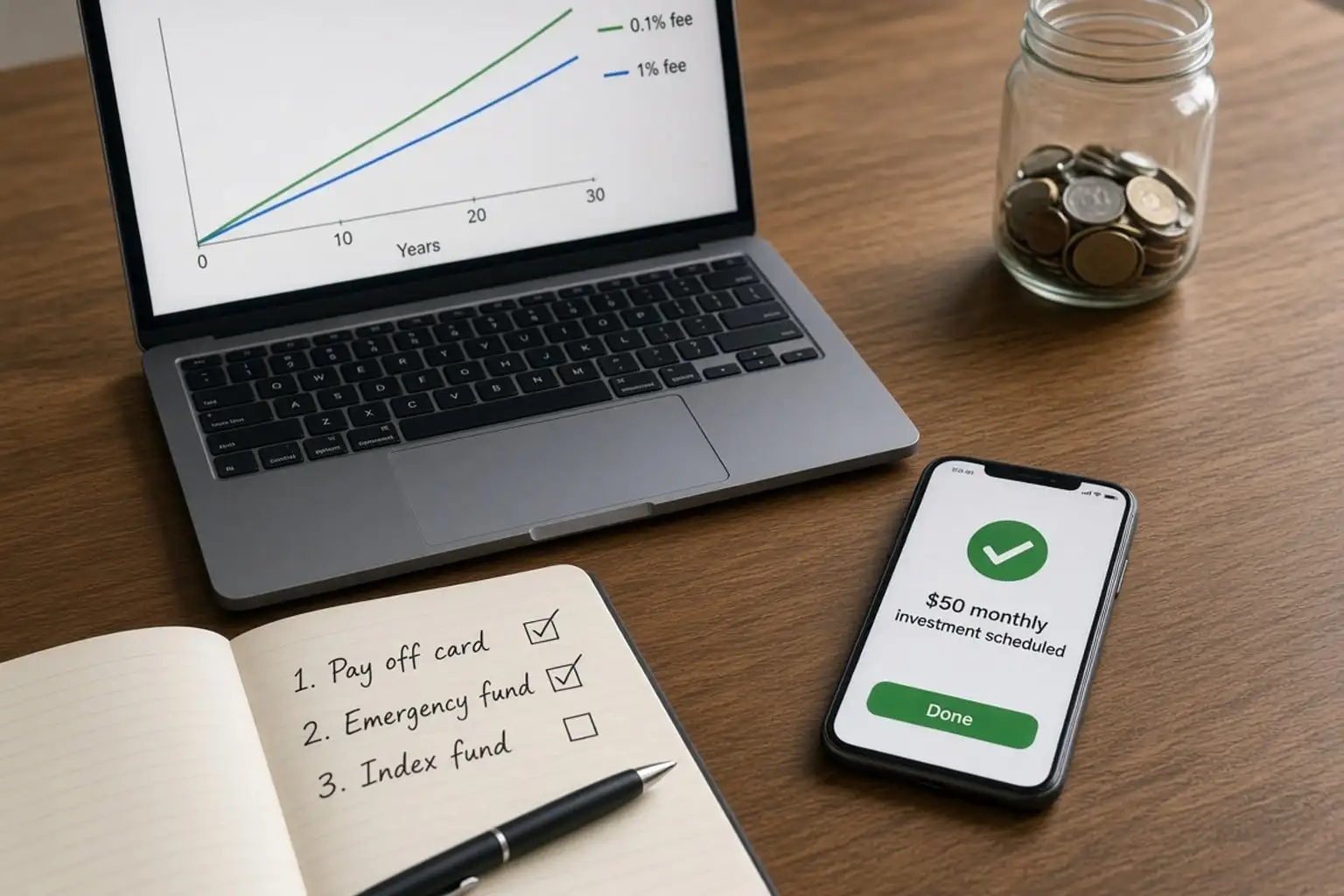
You do not need a lump sum to start investing. Many brokers now let you buy a slice of a fund for a few dollars, pounds or euros, and a regular $50 a month is enough to get started. What small amounts need more than big ones is a sensible order: clear expensive debt, keep some cash for emergencies, then put money into something broad and cheap, and leave it alone for years.
This guide walks through that order for readers anywhere in the world. It explains index funds, ETFs and fractional shares, shows what fees do to $50 a month over 30 years in a worked example we ran on November 19, 2026, and lists the hype and scams that target new investors with small budgets. For the wider picture, our investing basics hub collects the videos, articles and courses we point beginners to.
This isn’t financial advice; check with a licensed adviser in your country. We are an editorial team, not your adviser. We do not know your debts, your tax residency or when you will need the money, and we do not recommend any fund, share or provider. Investments can fall in value, sometimes for years, and you can get back less than you put in.
Before you invest: high-interest debt and an emergency fund
The UK government’s free guidance service, MoneyHelper, puts the usual order plainly in its guide to whether to pay off debt, save or invest first: deal with expensive debts and build an emergency fund first, then only invest money you will not need for the next few years. Its reasoning works in any country. Debts usually cost more than you can make on savings, and a credit card at 30% a year is a “return” no fund reliably beats.
So, in order:
- High-interest debt. Credit cards, overdrafts, payday loans and buy-now-pay-later balances. Paying one off is a certain return equal to its interest rate.
- An emergency fund. MoneyHelper’s rule of thumb is three to six months of essential outgoings in an instant-access savings account. If that looks out of reach, start with one month. If your income comes from side work that drops in a slow month, aim higher, not lower.
- Free money at work. If your employer matches pension or retirement contributions, that match is usually worth taking before anything else on this list.
Topic hubInvesting basics: Cash you can reach
The reason is not caution for its own sake. Without a cash buffer, the first broken boiler or lost contract forces you to sell, and markets have a habit of being down at exactly the moment you need the money.
How much money do you need to start investing?
Less than most people assume. Many brokers and fund platforms have no account minimum, and fractional shares let you buy a fund for less than the price of one unit. Robo-advisers often accept small first deposits too. Minimums change often and differ by country, so check the provider’s own pricing page rather than a list on a blog, including this one.
The more useful question is how much you can put in every month without stopping. A small amount added for 20 or 30 years usually matters more than the size of the first deposit. If the monthly number is the problem, the fix is on the income side: our guide to 50 ways to make money online lists side work with its catches, and the side-hustle income calculator shows what a few extra hours a week could add to a monthly contribution after costs.
Where small amounts go: index funds and ETFs
An index fund holds the companies in a market index, such as the US S&P 500 or a global index, instead of trying to pick winners. The SEC’s investor site defines it in its index fund glossary entry. An ETF (exchange-traded fund) is a fund that trades on a stock exchange like a share; many ETFs track an index.
For someone starting small, a broad index fund or ETF does two jobs at once. It spreads your money across hundreds or thousands of companies, so one failure does not sink you. And it is usually cheap, because nobody is paid to research which shares to buy.
There is also a long record showing how hard it is to beat an index after fees. S&P Dow Jones Indices publishes this twice a year in its SPIVA scorecards. In the SPIVA U.S. Year-End 2025 report, 79% of actively managed US large-cap funds trailed the S&P 500 in 2025, and the SPIVA results page puts the figure at about 90% over the 15 years to December 31, 2025. The pattern is similar in other regions S&P covers, though the numbers vary.
What a broad fund does not do is protect you from the market falling. A fund that holds the whole market drops when the market drops, and big falls of a third or more have happened several times in living memory. That is why the money should be money you can leave alone for at least five years, a timeframe MoneyHelper also uses in its guide to the risks of investing.
Topic hubInvesting basics: Broad funds and fees
Fractional shares: what they solve and what they don’t
A fractional share is less than one whole share. If a fund unit costs $500 and you invest $50, you own a tenth of a unit. That solves the “I can’t afford one share” problem, and it lets a fixed monthly amount be fully invested.
The catches are set by each broker, not by the market. The SEC’s bulletin on fractional share investing and FINRA’s guide to fractional shares list the main ones:
- You generally cannot transfer them. If you move to another broker, fractions may have to be sold first, which can trigger tax.
- Orders may be batched. Some brokers collect fractional orders and execute them later in the day, so the price you get can differ from the price you saw.
- Voting rights may not apply. Many brokers do not pass on shareholder votes for fractions.
- Not every fund or share is eligible, and availability differs by country.
None of these is a reason to avoid fractions. They are reasons to read your broker’s terms and pick a provider you are happy to stay with.
Fees: what 1% vs 0.1% costs on $50 a month
Fees matter more when you invest small amounts, not less. The SEC’s bulletin on how fees and expenses affect your portfolio shows $100,000 growing at 4% a year for 20 years: about $208,000 with a 0.25% annual fee and about $179,000 with 1%. You lose the fee and also the growth the fee would have made.
We ran the same idea at the scale most beginners start with.
Worked example, calculated November 19, 2026. Method: $50 paid in at the start of every month for 30 years ($18,000 in total), an assumed 5% a year return before fees, compounded monthly, with the annual fee taken monthly from the balance. No taxes, trading costs or inflation. The 5% is an illustration, not a forecast; actual returns vary year to year and can be negative.
| Annual fee | Value after 30 years | Fees charged | Gap vs 0.10% fee |
|---|---|---|---|
| 0.10% | $40,183 | $465 | none |
| 0.25% | $39,085 | $1,141 | $1,098 |
| 0.50% | $37,335 | $2,213 | $2,848 |
| 1.00% | $34,109 | $4,164 | $6,074 |
| 1.50% | $31,216 | $5,884 | $8,967 |
Two things stand out. The gap between a 0.1% and a 1% fee is $366 after 10 years, $1,975 after 20 and $6,074 after 30, or 15% of the final pot. And the gap is bigger than the fees themselves ($6,074 lost against $4,164 charged), because every fee dollar also stops compounding.
Flat fees can be worse on small balances. The SEC’s bulletin on subscription-based advisory fees, aimed at robo-adviser users, gives the example of a $3 monthly fee on a $500 account: $36 a year, more than 7% of the balance. A fixed $1 or $2 trading commission on a $50 purchase is 2% to 4% before the money has done anything.
The research agrees. Morningstar’s study of fund fees as a predictor of success found the cheapest fifth of US equity funds were three times as likely to succeed as the priciest fifth over 2010 to 2015. In Europe, ESMA’s 2025 market report on costs and performance of retail investment products, published March 2026, puts the average yearly cost of retail equity funds at 1.9% against 0.5% for equity ETFs over 2020 to 2024.
When you compare providers, add up three numbers: the fund’s ongoing charge (expense ratio), the platform or account fee, and any cost per trade or currency conversion.
Tax-advantaged accounts: the wrapper before the fund
Most countries give you an account type where investments grow with less tax, sometimes with limits on how much you can put in or when you can take it out. A few examples, from the official pages:
- United Kingdom: Individual Savings Accounts. GOV.UK’s ISA page says the maximum you can save across ISAs in the 2026 to 2027 tax year is £20,000; a stocks and shares ISA is the investing version. Workplace and personal pensions also get tax relief.
- United States: Individual retirement arrangements (IRAs) and workplace plans such as 401(k)s. The IRS IRA page explains the types, limits and withdrawal rules.
- Canada: the Tax-Free Savings Account. The Canada Revenue Agency’s TFSA page covers contribution room and withdrawals.
Many other countries have their own versions, often tied to retirement. Rules, limits and penalties change most years, which is exactly the kind of detail a licensed adviser or your tax authority’s website should confirm. If you live in one country and are a citizen of another, ask before you open anything.
How to start investing with little money, step by step
- Clear high-interest debt and keep at least a starter emergency fund in cash.
- Pick the account type first: a tax-advantaged account if your country has one that fits your timeframe, otherwise a standard brokerage account.
- Choose a regulated provider. Check it on your regulator’s register, such as the FCA Register in the UK or the SEC’s check-out tool on Investor.gov in the US. In the EU, use your national regulator’s register.
- Compare total costs using the three numbers above, at the amount you plan to invest each month.
- Choose a broad, low-cost fund whose holdings you can describe in one sentence. Whether that means a global fund, a home-market fund or a mix with bonds depends on your situation, which is where an adviser earns their fee.
- Automate a monthly amount you could keep paying through a bad year.
- Write down your rules (what you buy, how often, and what would make you change the plan), and check once a year, not every day.
Topic hubInvesting basics: Behavior is the strategy
What to skip: crypto hype, “signals” and scams
“Start investing with just $10” is also the opening line of a lot of things that are not investing. A few to treat with care:
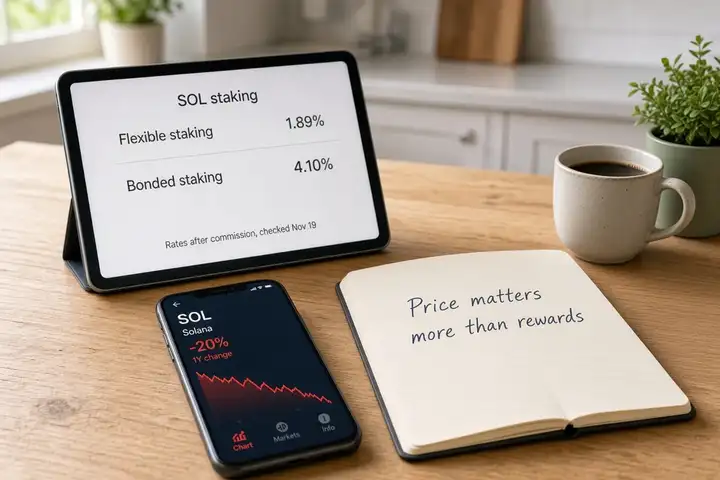
- Crypto as step one. The FCA’s page on investing in crypto says that if you buy crypto, you should be prepared to lose all the money you put in. If you want a small slice later, decide the amount when you are calm. Our page on where crypto fits, and the risks and our beginner’s guide to crypto are for readers who have already decided to look.
- Leverage, CFDs and copy-trading. They can lose more than you deposit, and you do not need them to invest.
- Paid “signals” groups and trading courses that show a brokerage screenshot as proof.
- Unexpected contact. A message, call or ad promising high or fixed returns, pressure to act today, or a request to move money to a wallet or account someone else controls. The FCA’s guide to protecting yourself from scams lists the warning signs, and scammers often pretend to be the regulator itself.
The same signs show up in fake money apps; our check of which money apps are legit covers those. If something sounds better than a boring broad fund with low fees, ask why someone is telling you about it.
Topic hubInvesting basics: What to treat as optional
Books and a course if you want the reasoning
If you want the case for index funds from the person who built the first one for ordinary investors, John C. Bogle’s short book makes it with numbers rather than charm.
Partner link: we may earn a commission, at no extra cost to you. Disclosure
JL Collins covers the same ground in a friendlier voice, with more on living below your means while you invest.
Our reading list of 10 money and investing books says which to read first depending on where your money is now.
For a course, Udemy’s Complete Investing Course (Stocks, ETFs, Index/Mutual Funds) covers index funds, ETFs, fees and compounding at beginner level. It also has chart and active-trading sections you can skip. Yale’s free-to-audit Financial Markets course with Robert Shiller is the university option, heavier on theory.
FAQ
Can you start investing with no money?
Not quite: you need some money to buy anything. But you can start with very little, and the first step costs nothing: list your debts by interest rate and open a savings account for the emergency fund. Our guide to ways to earn money in 2026 has ideas for raising the monthly amount.
Is $50 or $100 a month worth investing?
It can be, if fees are low and you leave it for decades. In our example, $50 a month at an assumed 5% return grew to about $40,000 over 30 years with a 0.1% fee. That is an illustration, not a promise; returns vary and can be negative.
How do I start investing in stocks with little money?
Most beginners get stock market exposure through a fund that holds many stocks, rather than picking single companies. Fractional shares let you buy either with small amounts. Single stocks carry much more risk, because one company can fall a long way.
Can I invest in property with little money?
Broad stock market funds already hold some property companies, and there are funds that hold listed property trusts (REITs). Property crowdfunding and fractional property platforms often restrict who can invest, can be hard to sell, and do not carry the same protections as a bank deposit. Read the risk warnings before you put money in.
How do I start investing with little money in the UK?
The same order applies: priority debts, emergency savings, your workplace pension, then a stocks and shares ISA if it suits your timeframe. MoneyHelper offers free, impartial guidance, and the FCA Register shows whether a provider is authorised.
Is a robo-adviser good for small amounts?
It can make choosing and rebalancing a portfolio simple. Check the fee at your balance: a flat monthly fee can be a large percentage of a small account, as the SEC’s subscription-fee bulletin shows.