People make money with crypto in a handful of ways: buying a coin that later rises, staking coins for rewards, trading, mining, and collecting free tokens from airdrops. Every one of them can also lose money, and most beginners who lose do it through fees, bad timing or a scam rather than through bad luck alone.
This guide covers each method in plain terms, with what it pays, what it costs and how it goes wrong. It includes staking rates we read on an exchange’s own page on November 19, 2026, a worked example of what fees and a price fall do to $1,000, and the tax and scam rules beginners most often miss.
This isn’t financial advice. We do not recommend any coin, exchange or product, and nothing here is a forecast. Crypto prices can fall a long way and stay down, exchanges can freeze withdrawals or fail, and you can lose everything you put in. Only use money you could lose without it changing your plans, and check the rules in your country before you start.
Before you buy any crypto
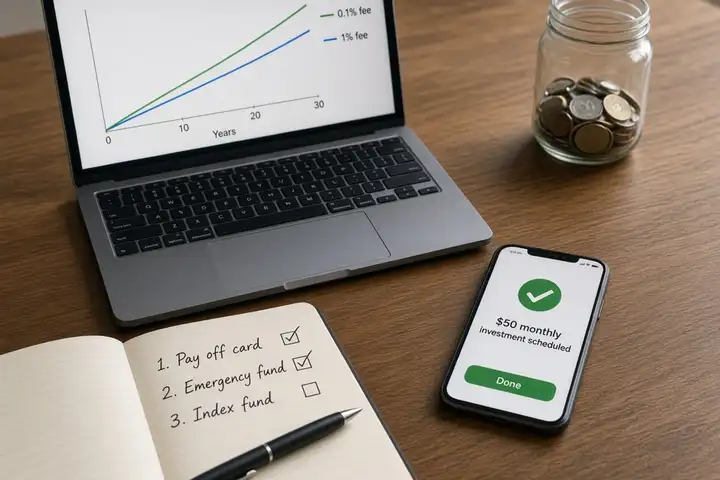
Crypto belongs after the basics, not instead of them. If you carry credit card debt or have no emergency savings, a coin’s next move is less important than that interest bill. Our guide to how to start investing with little money covers that order, and our investing basics hub explains why a broad, low-cost fund is the usual starting point.
Regulators say the same in their own words. The UK’s FCA, on its page about investing in crypto, says that if you invest in crypto you should be prepared to lose all the money you put in. In the EU, the three financial supervisors (EBA, EIOPA and ESMA) warned consumers in 2025 that crypto-assets can be risky and that legal protection, if any, depends on which assets and which provider you use, even under the EU’s MiCA rules.
If you still want to take part, decide two things while you are calm: the most you will put in, and what would make you stop. Write both down.
Buying and holding: you only gain if the price rises
The simplest way to make money with crypto is to buy a widely traded coin and hold it for years. You make money only if the price is higher when you sell than when you bought, after fees and tax. There is no income along the way.
Holding does not need skill, but it needs nerve. Large coins have fallen by more than half several times, and smaller ones often never come back. Buying a fixed amount every month (dollar-cost averaging) spreads out your entry price. It does not create a profit if the coin falls and stays down.
Two practical points:
- Where you hold it matters. Coins on an exchange are only as safe as that exchange. A self-custody wallet removes that risk and adds another: lose the recovery phrase and the coins are gone for good.
- Every trade costs money, which matters more the more often you buy and sell (see the fees section below).
Topic hubCrypto: Buying and holding
Staking: rewards in the coin, not a savings rate
Staking means locking coins that run on a proof-of-stake network, such as Ethereum or Solana, to help the network confirm transactions. In return you receive more of the same coin. Ethereum’s own staking page explains how it works at the protocol level.
Most beginners stake through an exchange, which runs the validators and keeps a share of the rewards as commission. To see what that looks like, we read the rates on Kraken’s public staking page and its commission rules on the same day. We use Kraken here because it publishes both; this is not a recommendation, and rates differ by country and change often.
Staking rates checked on November 19, 2026
Rates as shown on Kraken’s staking page at about 22:35 CET (Madrid time) on November 19, 2026. Kraken says these rates are estimates based on recent rewards, before its commission. The net columns apply the commissions in Kraken’s staking support article (updated the same day): 25% for bonded staking at the lowest balance tier and 30% for flexible staking. The last column shows the same bonded rate after Coinbase’s standard 35% commission, from Coinbase’s fees page, as a comparison of commission levels only, not Coinbase’s quoted rate.
| Coin | Bonded rate shown | Bonded, after 25% | Flexible rate shown | Flexible, after 30% | Bonded rate after a 35% cut |
|---|---|---|---|---|---|
| Ethereum (ETH) | 2.96% | 2.22% | not offered | n/a | 1.92% |
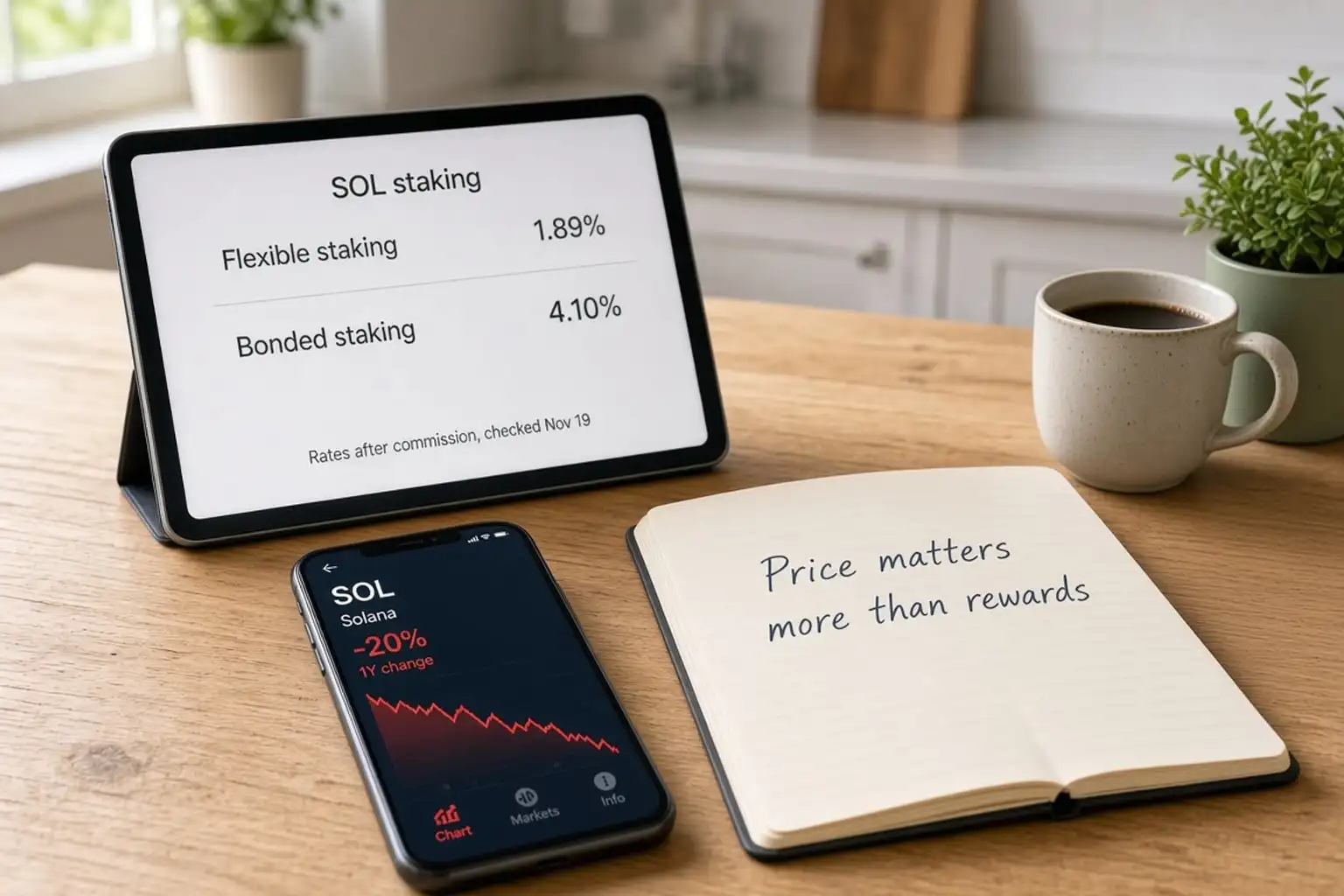
| Solana (SOL) | 5.47% | 4.10% | 2.70% | 1.89% | 3.56% |
| Polkadot (DOT) | 2.80% | 2.10% | 1.39% | 0.97% | 1.82% |
| Cosmos (ATOM) | 20.55% | 15.41% | 9.81% | 6.87% | 13.36% |
| Bitcoin (BTC) | 0.04% | 0.03% | 0.02% | 0.01% | 0.03% |
Method: we copied the shown rates and multiplied by (1 minus the commission). We did not compound or adjust for price. Bitcoin is not a proof-of-stake coin; the tiny BTC rate comes from a separate program.
What the table shows:
- Commissions take a quarter to a third of the reward. On Coinbase, its staking help page says the rate it shows is already after its commission.
- Flexible staking pays less. Kraken says that for flexible staking it only stakes part of your coins, and you receive rewards on up to 50% of them.
- A high headline rate is not a free lunch. Networks pay rewards partly by issuing new coins, so a double-digit rate can sit alongside a falling price. The rate is paid in the coin, and the coin’s price decides what it is worth to you.
Is crypto staking worth it, and is it safe?
Staking can add a few percent a year in coins to coins you already planned to hold. It does not make a falling coin a good holding. Kraken’s own risk list on the support page is a fair summary: no promise of any reward, rewards that can fall to zero, an unbonding wait during which you cannot sell, and the chance of losses from hacks or “slashing”, a penalty a network applies when a validator misbehaves. Some products sold as staking are lending your coins to a company, which adds the risk that the company fails.
What fees and a price fall do to $1,000: a worked example
Calculated November 19, 2026. Method: $1,000 buys Solana through Kraken’s instant buy, which its fee schedule prices at 1%. The coins are staked for one year at the bonded rate in our table, 5.47% before a 25% commission, so 4.10% net, paid in SOL. Then the coins are sold at the same 1% fee. We ignore tax, spreads, payment-method fees and any change in the staking rate.
| SOL price after one year | What you get back | Result |
|---|---|---|
| Down 50% | $510 | lose $490 |
| Down 20% | $816 | lose $184 |
| Unchanged | $1,020 | gain $20 |
| Up 20% | $1,224 | gain $224 |
The staking reward is worth about $41 over the year. The two 1% fees cost about $20, roughly half of it. And a 20% fall in price, a move many coins have made within weeks, wipes out more than four years of rewards. The price of the coin is the whole game; staking is a small adjustment on top.
Trading crypto: possible, and mostly a loss for beginners
Trading means buying and selling often to profit from price moves: day trading, swing trading, or using margin and futures to bet with borrowed money. Some people make money doing it. Many more lose, because every trade pays a fee or a spread, and leverage turns small moves into liquidations.
If you are drawn to trading, start with the costs. Kraken’s fee schedule lists 1% on instant and recurring buys and 1.5% on custom orders, while its separate Pro platform has its own volume-based fees. Coinbase’s fees page says simple buys include a spread in the quoted price, shown in the order preview. A trader who moves the whole account in and out once a week at 1% each way loses about two-thirds of it to fees in a year, even if prices go nowhere (0.99 to the power of 104 is about 0.35).
Our crypto trading page covers day, margin, swing and futures trading, with the warnings repeated next to each.
Mining, arbitrage and airdrops
These three come up in every search for ways to make money in crypto. For beginners, each has a catch.
- Mining. Bitcoin mining runs on specialised machines in places with cheap electricity. For most people paying home electricity prices, the power and hardware cost more than the coins they would mine. Check any mining-profit calculator against your own power bill before buying equipment, and treat “cloud mining” contracts that promise fixed daily returns as a warning sign.
- Arbitrage. Buying on one exchange and selling on another where the price is higher. The gaps are usually small and closed quickly by automated traders, and withdrawal fees and transfer times eat what is left. “Arbitrage bots” or groups that promise daily profits are a common scam pattern.
- Airdrops. Projects sometimes give free tokens to early users. Most airdrops are worth little, they can be taxable when received, and fake airdrop links are a standard way to get you to connect a wallet and approve a transaction that drains it. Our Web3 hub covers tokens and NFTs in more detail.
Making money with crypto without investing
You cannot make money from crypto prices without owning crypto. What you can do is get paid in it, or get paid for work around it: writing, design, support or development for crypto companies, often paid in stablecoins. That is ordinary work with a currency risk attached, and it is usually taxed as income.
“Learn and earn” quizzes and task apps pay tiny amounts. Before you spend evenings on them, put the time into our earnings-per-hour calculator. If you want income that does not depend on a coin’s price, our guide to 50 ways to make money online lists better-paid options with their catches, and the side-hustle income calculator shows what a few hours a week could bring in after costs.
Crypto tax: staking rewards usually count as income
Tax rules differ by country, and many tax authorities now receive data from exchanges. Two examples from official pages:
- United Kingdom. HMRC’s guidance on receiving cryptoassets says tokens from mining, staking or lending count as income. Selling, swapping or spending crypto can trigger Capital Gains Tax, per its page on selling cryptoassets. Swapping one coin for another counts as a disposal.
- United States. The IRS digital assets page says income from digital assets is taxable and lists staking and mining rewards among the things you must report. Its Revenue Ruling 2023-14 says staking rewards count as income at their market value when you gain control of them, including through an exchange.
HMRC’s page on the information you give crypto providers explains that providers report users’ details and that countries share this data under an international agreement. Keep a record of every buy, sell, swap and reward with its date and value, and ask a tax adviser in your country before you file.
Crypto scams: the biggest risk for beginners
The FBI’s 2025 Internet Crime Report counted 181,565 complaints involving cryptocurrency in 2025, with reported losses of $11.366 billion. Crypto investment fraud alone accounted for $7.228 billion, the largest loss of any crime type in the report. These are US complaints only; the patterns repeat worldwide.
The common shapes:
- Fake trading platforms and “investment mentors”, often met through a dating app, a wrong-number text or a social media group, that show growing balances you can never withdraw.
- Promised fixed daily returns, from staking pools, bots, mining contracts or arbitrage groups.
- Withdrawal fees and “taxes” you must pay first to release your money.
- Recovery services that promise to get stolen crypto back for an upfront fee.
- Impersonation of exchanges, celebrities or regulators. The FCA notes on its scam guidance that scammers pretend to be the regulator itself.
The same signs show up in fake money apps; our check of which money apps are legit lists them. No genuine exchange or regulator will ask for your recovery phrase.
A book and a course
If you want to understand why so many people lost money in the last boom, Zeke Faux’s reporting covers FTX, the scam compounds behind fake investment apps and the people who promoted them. It is a story, not a manual, and it is the best warning label we know.
Partner link: we may earn a commission, at no extra cost to you. Disclosure
For the mechanics, Udemy’s Blockchain and Bitcoin Fundamentals explains how blockchains, mining, wallets and safe storage work at beginner level. It is about how the technology works, not trading. Skip the sign-up offer in the first section if you have not decided to buy.
For money basics before any of this, our reading list of 10 money and investing books says which to read first.
FAQ
What is the safest way to make money with crypto?
None is safe. The least complicated is buying a large, widely traded coin in small amounts on a regulated exchange and holding it for years, with money you could lose. Staking adds a small reward and some extra risks.
Can you make money with crypto fast?
Anyone promising fast or fixed crypto profits is the main warning sign in the FBI’s scam figures. Quick gains do happen, and so do quick losses of half or more.
How much money do you need to start with crypto?
Many exchanges accept small amounts, often a few dollars or the equivalent. Check the fee on small trades: a fixed fee of $1 or $2 on a $20 purchase is 5% to 10% before the price has moved.
Is staking better than holding?
If you were going to hold the coin anyway, staking can add a few percent a year in more coins, minus commission. It adds lockups and platform risk, and it does not protect you from the price falling.
Do I pay tax on crypto if I don’t sell?
Often, yes, on staking and other rewards. In the UK and the US, rewards usually count as income when you receive them, and selling or swapping later can add a capital gains bill. Check your country’s rules.
Is crypto mining profitable at home?
For most people, no, once electricity and hardware are counted. Run the numbers with your own power price first.