Printful and Printify both let you sell printed products without holding stock. When a customer orders, a supplier prints the item and ships it. The difference is who does the printing, how the price is set, and what happens when a shirt comes out wrong.
This is a comparison, not a ranking. We are a partner of both companies, which we disclose because it matters: we get a commission if you sign up through the links in this article. The prices below come from each company’s public catalog on November 23, 2026, and from Etsy’s own fee pages, not from a sales pitch. We did not order samples from either supplier for this piece.
If you want the wider picture of samples, ads and returns, start with our print on demand guide. Nothing here is a promise that a shop will make money. Margins are thin, and a design that does not sell leaves you with only the cost of the samples you bought.
The short answer
Choose Printful if you want one company to print in its own facilities and to handle reprints when the print is at fault. The catalog price is the price, and quality should be more consistent from one order to the next.
Partner link: we may earn a commission, at no extra cost to you. Disclosure
Choose Printify if you want a network of independent print providers, so you can pick one by price, location or speed. The cheaper quote is often the point. Quality then depends on the provider you pick, and it can change if Printify later routes the same product to someone else.
For a first shop, the practical test is the same on both: order a sample of the exact product, color and print placement you plan to sell, photograph it, and only then open the listing. A mockup is not a sample.
How each one works
Printful is a printer. It owns and runs its fulfillment centers. You connect a store, upload a design, and pay Printful the catalog price plus shipping when an order comes in. If a manufacturing error happens, you deal with Printful. That is the appeal: one throat to choke, as operations people put it, and one set of print standards.
Printify is a marketplace of print providers. You still upload a design and connect a store, but each product is fulfilled by a provider in the network. On the Bella+Canvas 3001 page we opened, Printify listed a “Choice” option that picks a provider for you, and a “Choose manually” list of named providers in the US and elsewhere, each with its own starting price. You can pay less than Printful on some products. You also take on the job of comparing providers, and of ordering a new sample if you switch.
Both connect to marketplaces such as Etsy and to your own store, including Shopify. Integration is not the hard part. Pricing after fees is.
Topic hubDigital products: Print on demand
The same shirt, priced on November 23, 2026
To compare like with like, we used one product both catalogs sell: the Bella+Canvas 3001 unisex t-shirt, color White, size M, with a single front print. We did not log in. We read the public catalog pages in the afternoon of November 23, 2026, Europe/Madrid time (CET).
Printful. We opened its Unisex Staple T-Shirt (Bella+Canvas 3001) page, selected White, size M and DTG printing (the URL confirmed color=White and size=M), with one print included.
| View | Base price shown | Shipping, starting rate | Destination shown |
|---|---|---|---|
| United States | $11.92 | $4.95 | United States, delivery estimate Nov 28–30 |
| United Kingdom | £10.70 incl. VAT | £3.69 | United Kingdom, delivery estimate Nov 27–30 |
| Spain (our own browser) | €12.66 incl. VAT | €4.49 | Spain, delivery estimate Nov 27 |
Printful’s page says the price varies with technique, placement, color, size, taxes and shipping. The US and UK figures above are what that White/M page showed in those locations, around 16:05 CET. The Spain figures are what the same White/M URL showed in our browser, around 16:03 CET.
Printify. We opened its public Bella+Canvas 3001 page with the catalog set to USA and USD, and DTG selected, around 15:58–16:06 CET. The page quotes starting prices only, marked “From”:
| What the catalog showed | Amount |
|---|---|
| Base price, from | $11.29 |
| Same, from, with Printify Premium | $9.04 |
| Shipping, from (Economy, Express or Standard) | $3.99 |
The “Choose manually” list then showed per-provider starting prices under Premium, from $8.95 (Stakes Manufacturing) up to $11.97 (Fulfill Engine) among the US providers we could see, plus others outside the US. We could not confirm a White-only, size-M-only figure on those public cards, so the worked example below treats Printify’s numbers as starting prices and says so. If you need an exact quote, open the product in your own account, pick the color, size, placement and destination, and read the total before you set your retail price.
Shipping: the US, the UK and the EU
Shipping is often a third to a half of the supplier cost, so it belongs in the same decision as the shirt price.
On Printful, the starting rates on the product page are above. We also downloaded Printful’s official shipping-rates CSV at about 16:02 CET on the same day. That file is published in euros. For the “Shirts” category (t-shirts, tanks, long sleeves, polos and crop tops) it listed:
| Region in the CSV | First item | Each additional item (tier 1, up to 8) |
|---|---|---|
| USA | €4.69 | €2.10 |
| United Kingdom | €4.39 | €1.25 |
| Europe | €4.49 | €1.25 |
The Europe first-item rate of €4.49 matches the “shipping starts at: €4.49” line we saw on the Spain view of the product page. We are not converting those euro rates into dollars; the US product page already gives a dollar starting rate of $4.95.
On Printify, the only public shipping figure we could read was the catalog starting price of $3.99. The page did not show a separate UK or EU starting rate on that view, so we have not invented one. Provider, service level and destination will change what you actually pay.
Two reminders that catch new shops:
- If you offer free shipping to the buyer, you still pay the supplier’s shipping. Price the listing for that.
- A second item in the same shipment is usually cheaper than the first. Printful’s CSV makes that visible; Printify’s rate depends on the provider. Do not assume the first-item rate applies to every extra shirt.
Quality, samples and what happens when a print goes wrong
We did not order samples for this article, so we are not going to pretend we compared print sharpness or fabric feel. What we can say is structural.
Printful prints in its own facilities, so one company is responsible for the result and for a reprint or refund when it says a manufacturing error occurred. Printify routes the order to a provider. Quality can be good, and it can vary, which is why Printify’s own catalog copy talks about choosing providers and why a sample from the specific provider you will use is the only useful sample.
If you change provider to shave a dollar off the base price, treat that as a new product until a new sample arrives. A five-star listing with photos of provider A’s shirt will not save you if provider B prints a faded version.
Customer service still sits with you. The buyer wrote to your shop, not to the printer. A clear size guide, a photo of your sample, and a returns policy you can actually follow will prevent more arguments than any slogan about “premium quality.”
Plans that lower the product price
Both companies offer a free plan with no monthly fee, and a paid plan that discounts catalog prices once you sell enough for the subscription to pay for itself. We did not re-read the full plan pages for this comparison, so we are not repeating older monthly figures here. Look at each pricing page before you subscribe, and do the arithmetic on your own volume: a $25-a-month plan is only cheaper than the free plan if the discount on the products you actually sell is larger than $25.
On Printful’s White/M page, a built-in bulk calculator showed a discounted price of $10.37 for 25 items (13% off) on the US view, and £9.31 on the UK view. That is a quantity illustration on the catalog page, not a promise, and we did not use it in the single-sale example below.
On Printify, the catalog’s “from $9.04 with Printify Premium” line is the starting price after that plan’s discount, and we include it in the table as a starting figure only.
Selling on Etsy or on your own store
Etsy is the usual first storefront because buyers are already there. It also takes a visible cut. We read Etsy’s official pages on November 23, 2026:
- Listing fee: $0.20 USD per listing, from Etsy’s Fees & Payments Policy. Listings last four months. A multi-quantity listing that sells and auto-renews is charged another $0.20.
- Transaction fee: 6.5% of the price you display plus any shipping and gift wrap you charge the buyer, from the same policy and Etsy’s fees help article.
- Payment processing: a percentage plus a fixed amount that depends on where your bank account is, from Etsy’s Payments Policy and its processing-fee help article. For a United States bank account the table lists 3% + $0.25 USD. In the United Kingdom it is 4% + £0.20; in much of the euro area it is 4% + €0.30.
- Offsite Ads: 15% of attributed orders, or 12% once a shop has made $10,000 USD or more in the prior 365 days, from the Fees & Payments Policy. Below that threshold you can opt out; above it, participation is required. We leave this fee out of the worked example, then note what it would do.
Etsy also requires you to disclose a print-on-demand partner on the listing. If you sell jewelry or other handmade work as well, our handmade jewelry guide walks through the same fee stack on a finished piece. If you would rather sell a download than a printed shirt, our guide to selling Canva templates on Etsy covers Canva’s licence and Etsy’s fees on a digital file.
Your own store, for example on Shopify, swaps Etsy’s listing and transaction fees for a monthly plan and card fees, and it makes you responsible for every visit. That can leave more per order once you have traffic. It rarely costs less at the start. Our dropshipping guide is useful background even if you are printing rather than dropshipping: the part that transfers is the ad cost per order, which can wipe out a small margin.
What a $25 Etsy sale leaves: a worked example
Calculated November 23, 2026. Method: one Bella+Canvas 3001, sold on Etsy for $25.00 with free shipping to a US buyer, so the seller pays the supplier’s shipping and Etsy’s fees are charged on $25.00. The seller has a US bank account. We ignore sales tax, Offsite Ads, returns, advertising and any change in catalog prices. Figures are rounded to the nearest cent.
Printful uses the exact White/M US catalog figures. Printify uses the catalog starting prices, labelled as such.
| Printful, White/M (exact) | Printify, starting price (free plan) | Printify, starting price (Premium) | |
|---|---|---|---|
| Sale price | $25.00 | $25.00 | $25.00 |
| Base product | −$11.92 | −$11.29 | −$9.04 |
| Shipping (starting rate) | −$4.95 | −$3.99 | −$3.99 |
| Etsy listing fee | −$0.20 | −$0.20 | −$0.20 |
| Etsy transaction fee, 6.5% of $25.00 | −$1.63 | −$1.63 | −$1.63 |
| Etsy payment processing, 3% of $25.00 + $0.25 | −$1.00 | −$1.00 | −$1.00 |
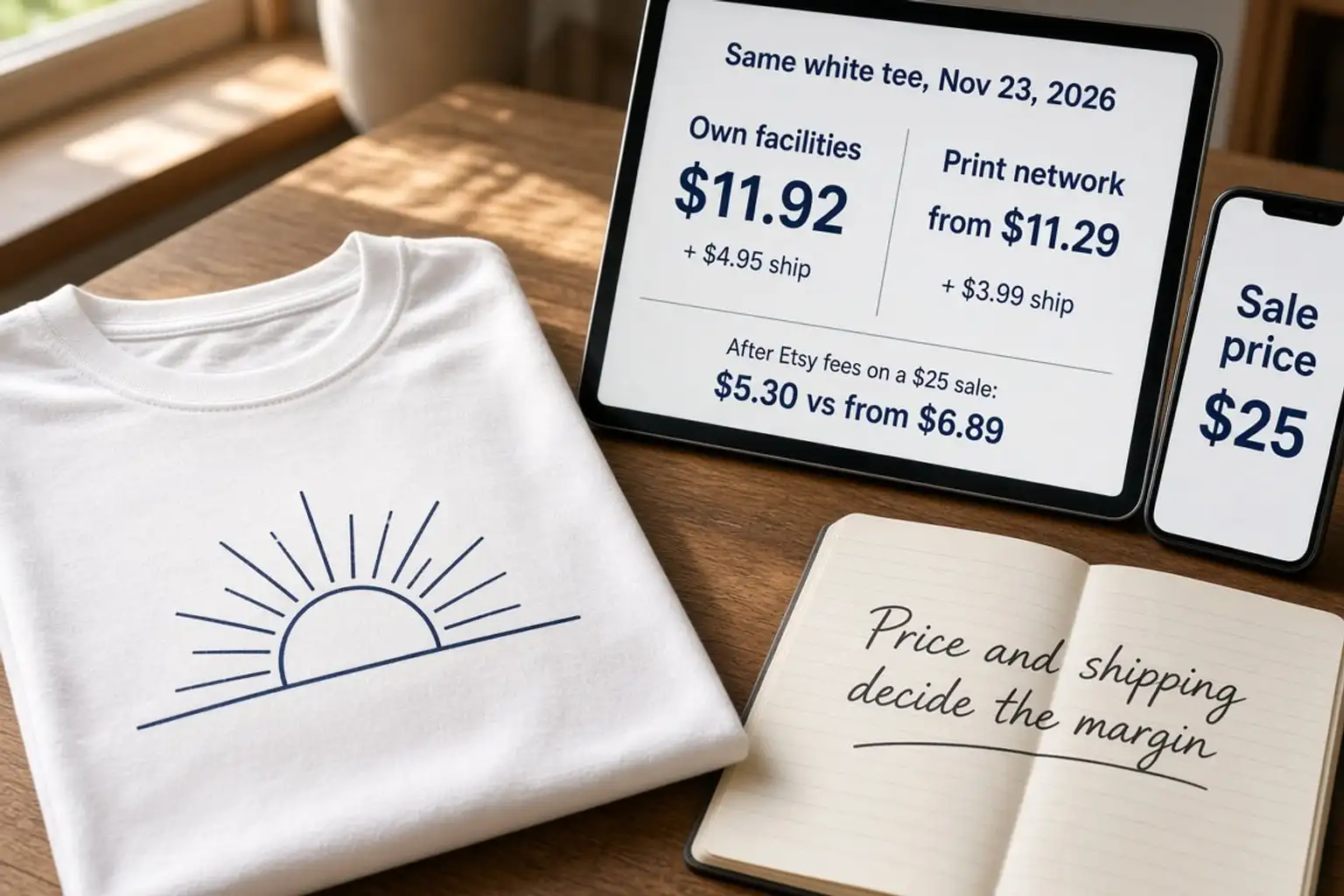
| Left before ads, returns and tax | $5.30 | $6.89 | $9.14 |
Etsy’s three fees come to $2.83 on this order, about 11% of the $25 price. If the same order arrived through an Offsite Ad at 15%, Etsy would charge another $3.75 and the Printful column would fall to $1.55. That is why a $25 shirt with free shipping has little room for paid traffic.
The gap between Printful and Printify’s starting prices is $1.59 on the free plan, before you ask whether the Printify quote is for the same provider, color, size and service level you will actually use. A sample, a reprint policy you have read, and a shipping destination you have checked will move the number by more than a headline “from” price.
Try your own price, ad cost and hours in the side hustle income calculator. If you want a sense of what the time is worth, use the earnings per hour calculator.
Mockups, product range and the rest of the catalog
Both catalogs go well beyond t-shirts: hoodies, mugs, posters, bags. The cheapest item in a category is not always the one that leaves a margin once shipping and a possible return are included. Price the product you will actually sell, in the color and size you will stock on the listing, to the country you will ship to.
Supplier mockups are fine to start a listing. A photograph of your sample, worn or held, usually sets better expectations about color and print size. That advice is the same whichever supplier you pick.
Other print networks exist. If a third option appears in your search, use the same method: one product, one color, one size, today’s shipping to your buyer, then Etsy’s fees. Do not compare a “from” price in one tab with an exact size in another.
Who should skip both, and who should start small
Skip print on demand if you need income this month, if you have no money for samples, or if your plan is to upload hundreds of generic designs and wait. The guide to 50 ways to make money online is a better starting point in those cases, and our digital products hub explains why a specific file can leave a wider margin than a shirt.
Start small if you already have a design people ask for, or a small audience that would wear it. Pick one supplier, one product, one listing, and a sample you have seen with your own eyes. Add a second product only when the first one has sold enough times that you trust the numbers.
FAQ
Printful vs Printify: which is cheaper?
On November 23, 2026, Printify’s public catalog showed a lower starting price on the Bella+Canvas 3001 than Printful’s exact White/M US price, and a lower starting shipping rate. “Starting” is doing a lot of work in that sentence. The cheap quote may be a different provider, color, size or service level. Check the total for your exact order.
Which is better for Etsy?
Both connect to Etsy. Etsy’s fees are the same whichever printer you use. The better fit is the one whose samples, shipping times and reprint rules you can stand behind in your listing. Disclose the print partner, as Etsy requires.
Do I need a paid plan?
No. Both have a free plan. A paid plan only helps if the discount on the products you sell is larger than the subscription. Recalculate when your volume changes.
Is print on demand still worth it?
It can be, for a design people already want, with traffic that does not cost more than the margin. It is a product business with a printer attached, not a shortcut around marketing. Our print on demand guide covers samples, ads and returns in more detail.