Beehiiv and Substack both let you publish a newsletter, collect email addresses and, if you want, charge for some of the writing. They take money out of that in different ways. Substack is free to use and keeps 10% of each paid subscription, plus Stripe’s fees. Beehiiv charges a monthly plan once you want paid subscriptions, and says it keeps 0% of that revenue, again plus Stripe.
This comparison is about those fees, and about what you give up or gain around them: discovery, the list, branding, and the tools for a free newsletter. It is not a forecast of how many people will pay you. Most newsletters stay free for a long time, and many never charge.
A conflict you should know about. We are a partner of beehiiv. If you sign up through our link, we may be paid. We are not a partner of Substack. The fee figures below were read from each company’s official pages on November 23, 2026, and put through a short script. We have not run a paid newsletter on both platforms.
Partner link: we may earn a commission, at no extra cost to you. Disclosure
If you would rather write posts that people find through search, see our look at whether blogging is still profitable. If you want other ways to get paid online first, our guide to 50 ways to make money online is the wider list.
The short answer
Choose Substack if you want to start at $0, you care about being discovered next to other writers, and you are willing to pay 10% of each paid subscription for that. It is a simple deal: no monthly bill, a cut when someone pays you.
Choose beehiiv if you already know you will charge, or you want automations, a site, and its recommendation and ad tools, and you prefer a flat monthly plan with no platform cut of paid subscriptions. At a small paid list the two can cost almost the same. The 10% starts to hurt as the list grows.
Kit (formerly ConvertKit) is a third option, also a partner of ours, with a free plan up to 10,000 subscribers. It is built for creators who already have a list and want forms, broadcasts and, on a paid plan, automations. It does not try to be a writing network in the way Substack does.
None of these tools will find your first 100 readers for you. The writing and the consistent schedule do that.
Topic hubCreator economy: Newsletters
How each platform makes money from you
Substack, on its official page How much does Substack cost? (updated 29 October 2026, read by us on 23 November 2026), says publishing is free no matter how many subscribers you have. If you turn on paid subscriptions, “Substack keeps 10% of subscription revenue, and Stripe charges its own payment processing fees.” Readers pay the price you set. The same page lists:
| Fee | Amount, as Substack states it |
|---|---|
| Substack fee | 10% of each subscription payment |
| Stripe card processing | 2.9% + $0.30 per payment for US cards |
| Stripe Billing (recurring payments) | 0.7% |
| Custom domain (optional) | A one-time $50 |
Substack does not add a fee on top of web payments. Subscriptions bought in its iOS app may cost readers more to cover Apple’s fees; we leave in-app purchases out of the table below.
Beehiiv, on its pricing page on the same day, showed yearly billing as the default:
| Plan | Price shown | Subscriber cap, from the FAQ |
|---|---|---|
| Free | $0, free forever | Up to 2,500 |
| Lite | $49 a month, yearly billing | Up to 100,000 |
| Pro | $95 a month, yearly billing | Up to 250,000 |
| Enterprise | Custom | Custom |
The page lists paid subscriptions, at a “0% take rate,” as a Lite feature (and therefore also on Pro). The free plan includes unlimited email sends, templates, landing pages, the recommendation network, and an API. It does not list paid subscriptions.
A FAQ on the same page is direct: “Do you take a cut of my paid subscriptions or product sales? No. beehiiv takes 0% of your paid subscription and digital product revenue. You keep what you earn, minus Stripe’s standard processing fee of 2.9% + $0.30 per transaction.”
Two gaps to be fair about. Beehiiv’s page does not list Stripe’s 0.7% Billing fee, which Substack’s table includes. We have not assumed that fee on beehiiv. And we did not click the monthly-billing toggle, so we are not quoting a month-to-month Lite price; the page says yearly billing saves up to 20%, which is not a precise enough figure to invert.
What you keep at $5 a month: a worked example
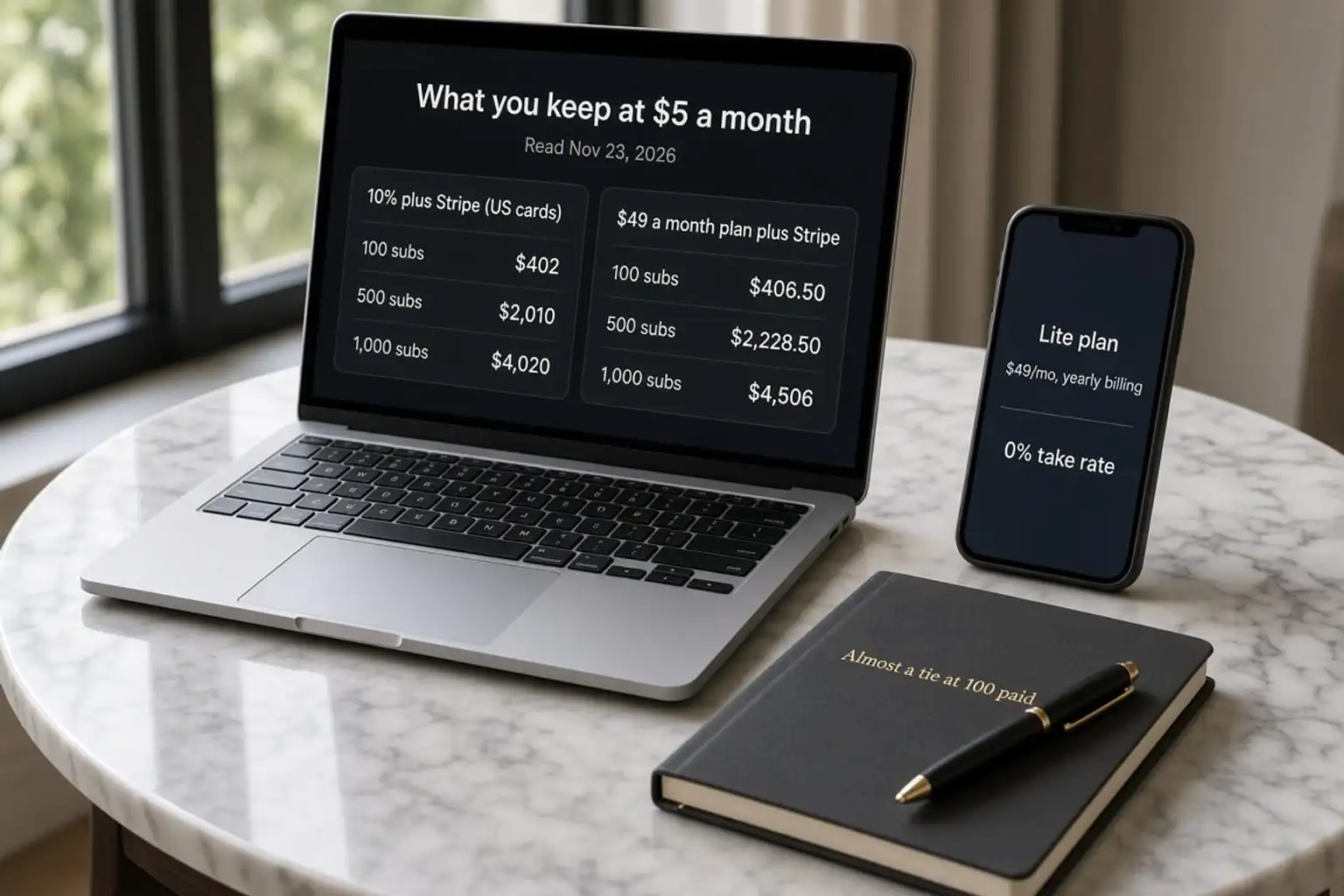
Calculated November 23, 2026. Method: 100, 500 or 1,000 people each pay $5 a month, billed monthly, on US cards. Every subscriber is a paying subscriber, so the list size and the paid count are the same. No sales tax, no annual plans, no Apple in-app fees, no custom domain. Substack’s fees follow Substack’s own table (10% + 2.9% + $0.30 + 0.7%). Beehiiv’s fees follow beehiiv’s own wording: the $49 Lite plan (yearly billing) plus 2.9% + $0.30, and no platform cut. All three sizes fit Lite’s 100,000 cap, and paid subscriptions on beehiiv require Lite or higher.
| Paid subscribers | Monthly revenue | You keep on Substack | You keep on beehiiv Lite | Difference |
|---|---|---|---|---|
| 100 | $500 | $402.00 | $406.50 | Beehiiv ahead by $4.50 |
| 500 | $2,500 | $2,010.00 | $2,228.50 | Beehiiv ahead by $218.50 |
| 1,000 | $5,000 | $4,020.00 | $4,506.00 | Beehiiv ahead by $486.00 |
On a single $5 payment, Substack’s 10% is $0.50. Stripe’s 2.9% is $0.145, the 0.7% Billing fee is $0.035, and the fixed fee is $0.30, which comes to $4.02 left per subscriber after ordinary rounding in the script. Beehiiv’s Stripe line, as beehiiv states it, is $0.45 per payment, plus $49 of plan cost spread across the list.
The useful reading is not “beehiiv wins.” At 100 paying subscribers the two are almost a tie, and that $4.50 gap would vanish if Stripe Billing also applied on beehiiv, which we have not claimed. At 500 and 1,000 paid, Substack’s 10% is a much larger bill than $49. If your paid list is still in double digits, the fee is not the reason to pick one. If you already have hundreds of paid subscribers, it is.
These numbers assume everyone stays and pays. They do not include the time it takes to write, or refunds, or failed payments. If you want to put a value on the hours, try the earnings per hour calculator. For a rough monthly view of a small side project, use the side hustle income calculator.
Starting for free, and when you have to pay
On Substack you can publish for free indefinitely. You only pay when a reader pays you, and only then the 10% plus Stripe.
On beehiiv you can also start for free, up to 2,500 subscribers, with the recommendation network included. You need Lite (or higher) to turn on paid subscriptions, at $49 a month on the yearly billing we were shown. If you have 800 free readers and you want to charge, you are paying $49 a month before the first paid subscriber, which is a different shape of risk from Substack’s cut.
That is why “which is cheaper” depends on whether you charge, and how much comes in, not on a single monthly sticker.
Discovery, the list, and who holds the relationship
Substack’s pitch is the network: Notes, recommendations, and a homepage of other writers. That is worth something if strangers actually find you there. It is also why some writers stay even when the 10% looks expensive. We cannot measure that discovery for you, and we did not try to.
Beehiiv’s pitch is the toolkit: a site, a recommendation network of its own, ads, automations on Lite, and, on Pro, the option to remove beehiiv branding. The free plan already includes the recommendation network and a website.
On both, you should still export your list. The addresses are the part a platform cannot fully replace if you leave, but only if you actually have them and the right to email them. Check each platform’s export and terms before you need them. A custom domain, where you use one, also makes a move less painful. Substack charges a one-time $50 for that, per the fee table above. We did not read a beehiiv custom-domain price today, so we have not compared it.
Growth tools, ads and paid subscriptions
Substack’s paid offering is built in: you set a monthly, yearly and founding price (the official setup article says the minimum is $5 a month and $30 a year for US-dollar Stripe accounts). Payments go through Stripe.
Beehiiv’s Lite plan adds paid subscriptions with no beehiiv cut, automations, audience polls, A/B tests, and ads through its ad network. The pricing cards we saw also printed “Avg. $39/mo” next to ad monetization. That is beehiiv’s own average figure, not a promise of what your list would make, and we have left it out of the worked example.
Pro, at $95 a month on yearly billing, adds the removal of beehiiv branding, advanced analytics, webhooks, dynamic content and priority support, among other items on the page. You do not need Pro to charge readers.
If a newsletter is only one channel next to video or social accounts, read our creator economy hub for how the pieces fit. Threads and X have their own pages if that is the distribution you already have: Threads and how to make money on X.
Who should start where
Start on Substack if you are not ready to pay a monthly bill, you want a writing-network audience, and you can live with 10% later. You can still export and move if the math changes.
Start on beehiiv if paid subscriptions or automations are part of the plan from week one, or you already have enough paid readers that 10% is more than $49 a month. Do the arithmetic on your actual paid revenue, not on a hoped-for number.
Start with neither, and just collect addresses, if you have not yet written ten issues. A simple landing page and a consistent schedule will teach you more than a platform comparison. The creator economy hub is the better first read in that case.
FAQ
Does Substack take 10% of free subscriptions?
No. Substack’s fee applies to paid subscription payments. Publishing a free newsletter is free, per its official cost page.
Does beehiiv take a cut of paid subscriptions?
Not according to its pricing FAQ on November 23, 2026: it says 0%, minus Stripe’s 2.9% + $0.30. Paid subscriptions are a Lite (or higher) feature, so the plan cost still applies.
When does a flat plan cost less than Substack’s 10%?
On the assumptions in our table, the two are almost level at 100 paid subscribers at $5 a month. Beehiiv’s $49 plan is clearly cheaper than a 10% cut once paid revenue is in the hundreds of dollars a month, as the 500 and 1,000 rows show. Your price, annual plans and any extra Stripe fees will move the break-even point. Recalculate with your own numbers.
Can I move my list later?
Usually yes, if you export it and your subscribers agreed to hear from you. Read the export tools and terms on both sides before you need them, and prefer a domain you control.