NFTs are not dead in 2026, but the boom is over. They still trade, in much smaller amounts, and most collections never find a second buyer. Buying one in the hope that a stranger will pay more later is speculation with thin demand, not a plan for rent.
That is a quieter answer than the old videos promised. A token can still be a receipt for a digital work, a ticket or a membership. The market that treated profile pictures as a shortcut to wealth did not hold. Our Web3 and NFTs hub is clear about how much of that hype is left, and this page goes through the evidence, what still exists, and the catches that matter if you mint, buy or sell one.
This isn’t financial advice. We do not recommend any coin, collection, marketplace or course. Crypto prices can fall a long way, tokens can become unsellable, and you can lose what you paid if a project or a marketplace disappears. Check the rules where you live before you start.
Are NFTs dead in 2026?
Not dead, but the boom is over. Trading still happens in a much thinner market, and most collections never find a second buyer.
“Dead” is the wrong word if you mean “the tokens vanished.” They did not. People still mint them, list them and, now and then, sell them. “Dead” is closer to the truth if you mean “the 2021 and early-2022 rush, when new buyers arrived every week and floors only seemed to go up.” That rush ended. What remains is a niche collectibles market with far less money in it, and a long tail of tokens that have no bid.
If you want a side income that does not depend on finding a later buyer, our guide to 50 ways to make money online is the better starting point, and the side-hustle income calculator and earnings-per-hour calculator will show what a few hours of ordinary work could be worth after costs.
What is an NFT, in plain terms?
An NFT, or non-fungible token, is a unique token on a blockchain that points to a file or a right. Creating one is cheap. Selling one is not.
The token is the record: it can say you hold item number 184 in a collection, or a pass for an event, or a license the issuer described in its terms. It is not automatically the copyright in the image, and it is not automatically a share in a company. Owning the token is not always the same as owning the art.
Most NFTs sit on Ethereum or on networks that copy its model, including Solana and others. You usually pay a network fee to mint or to move one, on top of any marketplace fee. Royalty settings, the extra cut some marketplaces once sent back to the artist on resale, are not reliably enforced. If a marketplace lets a buyer skip that cut, many will.
For a wider picture of how tokens, wallets and fees work, start with our beginner’s guide to crypto. The warnings there apply here too.
What actually collapsed after 2021?
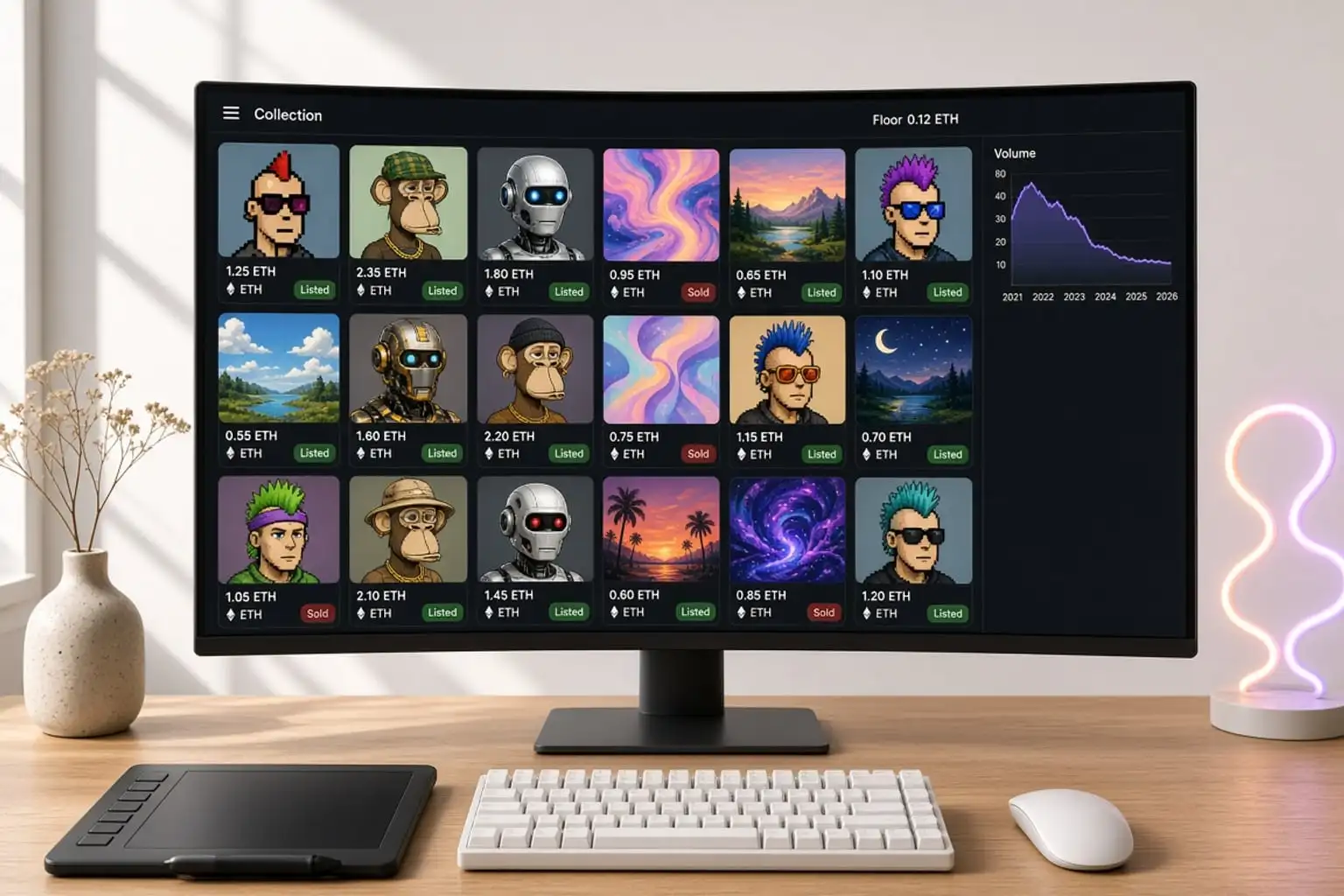
The buyers. Monthly marketplace volume is a small fraction of the January 2022 peak, and a large share of that peak was wash trading.
The Block’s NFT dashboard, updated on 26 November 2026 at 1:06 a.m. Eastern, put monthly marketplace volume at $132.9 million (The Block, NFT data). In late January 2022, the same outlet reported that monthly NFT trading volume had already reached a record $6.13 billion on its data dashboard (The Block, 29 January 2022). That 2022 total included a large share of wash trading on LooksRare, which The Block Research flagged at the time, so the peak, after that caveat, was lower than the headline. Even with that caveat, today’s monthly figure is a small fraction of the boom-year number.
Wash trading is the practice of trading items back and forth, often with yourself or with a partner, to make a collection look busy. It inflated some headline volumes then, and it has not disappeared. When you see a sudden burst of sales in a little-known collection, it is worth asking whether money actually changed hands between two strangers.
The other thing that collapsed was the story. “Mint now, sell later” needed a constant stream of new buyers. When that stream slowed, floor prices fell, listings sat, and a lot of later collections never found a first buyer, let alone a second. Marketplace fees did not go away. Royalties became optional on some platforms. Several NFT storefronts that had been attached to large crypto brands later shut down or scaled back. The tokens remain on the chain. The crowd did not.
What still exists?
Some art and collectible sales, game items, and tokenized tickets or memberships. None of that restores the old floor prices.
A thinner market is not an empty one. Artists who already have an audience sometimes still sell editions, usually in smaller numbers and at quieter prices than the screenshots from 2021. A few older collections still trade, often in bursts. Game items, event tickets and membership passes are the use cases that always made more sense than a profile picture with no other job: the token is a pass, not a promise that a stranger will bid it up.
That is not a reason to buy a collection because a thread called it “undervalued.” Utility is only useful if you wanted the underlying thing anyway, the way you would want a ticket or a club membership. If the only reason to buy is the later sale, you are back in speculation, just with a story attached.
Play-to-earn games, where you were told to buy a character and then get paid to play, belong in the same “buyers left” bucket as NFT flipping. Our Web3 hub covers that briefly. A longer look at what is still worth it in those games is a separate question, and not the one this page is here to answer.
Can you still make money flipping NFTs?
Only as speculation, and the demand is thin. There is no reliable spread you can count on for rent.
Flipping means buying a token in the hope of selling it later for more, after fees. In a busy market with new buyers arriving, some people did that and sold in time. Many more bought near the top, or bought collections that never found a second bid. Fees cut both ways. So does the gap between the listed floor and a price anyone will actually pay.
There is no honest way to turn that into a schedule. A sale is not a wage. A floor price is not a job. Wash trading can make a dead collection look alive for a day. If someone sells you a course on “NFT flipping in 2026” with screenshots of old profits and a private Discord, treat it as a sales pitch, not as evidence that the buyers came back.
If what you want is paid work around crypto projects, without buying a token to get in the door, that is a different path: writing, design, support or development, invoiced in cash or a stablecoin you can cash out. Our guide to getting paid for Web3 work without buying a token is about that work. It is not about flipping collectibles.
If you make art, should you mint an NFT?
Mint after you have buyers, and price the work as art, not as an investment product.
Minting is the easy step. You can create a token in minutes and pay a network fee. The hard step is the same one every artist already knows: finding people who want the work. A collection of a thousand items with no audience is a thousand listings in a quiet shop. A small edition sold to people who already follow you is a more fitting use of the tool.
Price the work as art, or as a membership, or as a ticket. Do not price it as a financial product with an implied future buyer. Say clearly what the token includes, and what it does not: copyright, commercial rights, and any promise of later payouts should be written down, not hinted at in a thread. Keep a copy of the files yourself. The token points at a file; if the file host disappears, buyers are left with a record and no picture.
If you cannot describe the buyer, do not mint a thousand. If you can describe the buyer, you may not need a thousand.
Tax, records and the usual scams
In the US, the IRS treats NFTs as digital assets and as property. Keep records. Do not connect your wallet to a site that promises a free mint.
US taxpayers should start with the IRS digital-asset pages, not with a thread. The IRS treats digital assets, including NFTs, as property, not as currency (IRS, Digital assets). Selling or exchanging one can produce a capital gain or loss. If you create and sell NFTs in a trade or business, or you are paid in them for work, that is usually ordinary income, reported the way you would report other business or wage income. Broader digital-asset reporting rules that took effect for transactions on or after 1 January 2025 are explained in the IRS FAQs (IRS, digital asset FAQs, Part II).
Some NFTs may also be treated as collectibles. In Notice 2023-27, the IRS said it will look through the token to the thing it represents. An NFT that stands for a work of art or another listed collectible can fall under the collectibles rules, which can mean a higher long-term capital gains rate than the usual rate on other assets; an NFT that stands for a right that is not a collectible generally would not (IRS Notice 2023-27). That notice is interim guidance, not a final regulation. Keep records of what you paid, when, in which currency, and what you received when you sold or were paid. This is not tax advice. If the amounts are material, ask a tax professional who works with digital assets.
In the UK, HMRC also treats cryptoassets as property. Selling an NFT can fall under capital gains tax; if you mint and sell as a trade, income tax and National Insurance can apply. Check HMRC’s cryptoassets manual for the current framing, and do not assume a US rule applies.
In the EU, tax treatment varies by country. MiCA sets rules for many crypto-asset service providers, but it is not a single EU-wide NFT income tax. Check your national tax authority. Do not treat a marketplace’s location as your tax residence.
Scams in this corner are repetitive because they work. A site offers a “free mint” or a surprise airdrop and asks you to connect a wallet and approve a transaction that drains it. A support account in a comment thread sends you to a fake marketplace. A collection copies a well-known name with one letter changed. A course promises a method that cannot fail. The usual defenses are dull and effective: type the marketplace address yourself, never approve a transaction you do not understand, and do not keep more in a hot wallet than you can stand to lose.
If this is not for you
Ordinary paid work and unglamorous investing are the usual alternatives.
If you like making things, sell the thing to people who want it, in a currency you can use for rent. If you are curious about crypto itself, read the beginner’s guide for holding, fees and scams, and the investing basics hub before you treat any token as a plan. If you were considering trading, whether crypto trading is profitable and how to trade crypto for beginners are the next pages to read, and they do not flatter the odds.
NFT flipping is not on that list because it is not a wage and it is not a broad market any more. A niche can stay alive without being a good use of money you need.
Books and a course
You do not need an “NFT investing” course to understand why the boom did not last. A short book on how people behave with money, and a basic investing course, are more useful than a playbook for a market that no longer has the old crowd of buyers.
Partner link: we may earn a commission, at no extra cost to you. Disclosure
The Psychology of Money by Morgan Housel is about behavior rather than charts: greed, fear, patience and knowing when you have enough. It is a good counterweight if a boom-era screenshot still feels like a plan.
If you want a structured introduction to ordinary investing, Investing For Beginners: The Complete Course by Steve Ballinger on Udemy covers stocks and the usual portfolio habits first. Use it to learn the basics, not as a reason to buy a collection.
FAQ
Are NFTs dead in 2026?
Not entirely, but the boom is over. They still trade in a much thinner market, and most collections never find a second buyer. Buying one to flip is speculation, not a plan for rent.
Do I need to buy an NFT to work in Web3?
No. Paid work for crypto projects is ordinary writing, design, support or development. Invoice in cash or a stablecoin you can cash out, and skip jobs that require you to buy a token to start. Our guide to Web3 work without investing covers that path.
Are NFT royalties still paid to artists?
Not reliably. Some marketplaces still honor a royalty setting, and some let buyers skip it. Do not treat a royalty percentage as income you can count on.
How are NFTs taxed in the US?
The IRS treats NFTs as digital assets and as property. Sales can be capital gains or losses. Creating and selling as a business, or being paid in NFTs for work, is usually ordinary income. Some art-like NFTs may be treated as collectibles. Keep records, and read the IRS digital-asset pages. This is not tax advice.
Is it safe to connect my wallet to an NFT site?
Only if you typed the address yourself and you understand the approval you are being asked to sign. Fake mints and fake airdrops are a standard way to drain a wallet. Do not keep more in a connected wallet than you can stand to lose.
Sources
- The Block, NFT market data dashboard, updated 26 November 2026, 1:06 a.m. Eastern: monthly marketplace volume $132.9 million.
- MK Manoylov, Monthly NFT trading volume reaches all-time high of $6 billion in January, The Block, 29 January 2022 (updated 30 January 2022). The article notes that a large share of LooksRare volume was wash trading.
- IRS, Digital assets and Frequently asked questions on digital asset transactions.
- IRS, Notice 2023-27, treatment of certain NFTs as collectibles.
- HMRC, Cryptoassets manual.