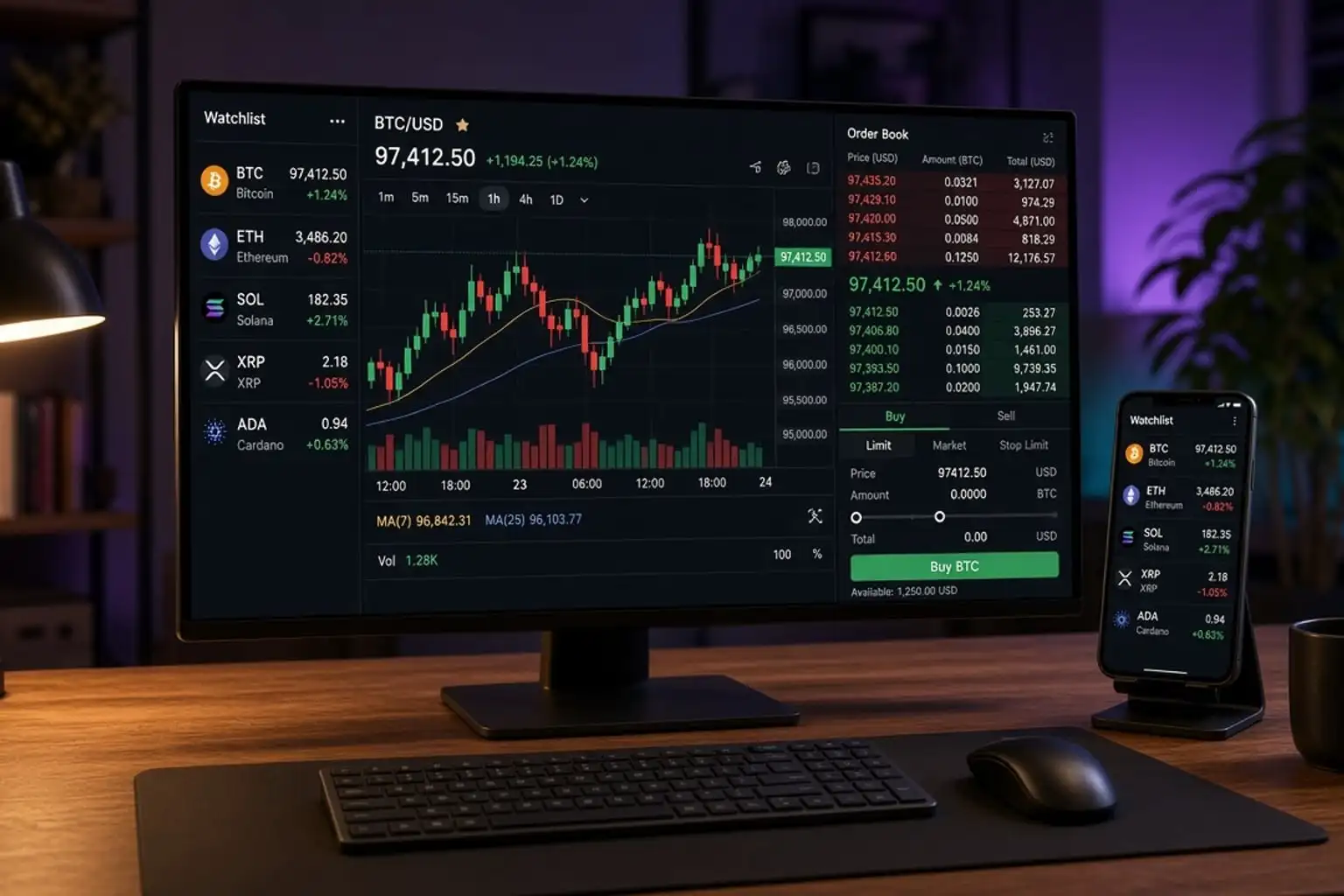
To trade crypto, you open an account with an exchange that is allowed to serve customers where you live, verify your identity, deposit money, and place buy and sell orders on a trading pair such as BTC/USD. The careful version adds three habits before the first order: decide how much you can lose on one trade, set a stop-loss, and practice with pretend money first.
This guide walks through each step for spot trading, which means buying and selling the coin itself without borrowed money. It covers how to check that an exchange is allowed to serve you, what the identity checks involve, the order types you will see, the fees and spreads behind every trade, how to size a position, and what to keep for tax.
Whether trading is worth it at all is a separate question. Central-bank and regulator data show most retail traders lose money, and our article on whether crypto trading is profitable goes through the numbers. Read it first if you have not decided.
This isn’t financial advice. We do not recommend any coin, exchange or strategy. Crypto prices can fall a long way and stay down, exchanges can freeze withdrawals or fail, and you can lose everything you put in. Check the rules in your country before you start.
Step 1: Choose an exchange that is allowed to serve you
A crypto exchange holds your money and coins while you trade, so the first test is not low fees. It is whether the company is allowed to serve customers where you live. Each country, and in the US each state, sets its own rules, so check the official register for your location before you deposit.
- In the US, a crypto exchange is generally treated as a money transmitter, so it must register with FinCEN as a money services business, or MSB (FinCEN guidance FIN-2019-G001). Search the company’s legal name on FinCEN’s MSB Registrant Search page. The list shows only what the firm reported, so treat it as a minimum check, not an endorsement. States also license money transmitters separately, and a FinCEN registration does not replace that: New York, for example, requires a BitLicense (NYDFS). Check the state license on NMLS Consumer Access or with your state’s financial regulator. The SEC and the CFTC also oversee parts of the crypto market, and Investor.gov collects their investor alerts.
- In the UK, check that the firm is on the FCA register. Firms marketing crypto to UK consumers must also follow the FCA’s promotion rules.
- In the EU, firms serving EU customers have needed a MiCA license since the transition period ended on 1 July 2026, and ESMA tells consumers to check that their provider is listed in its interim MiCA register before they invest or transfer funds (ESMA statement, April 2026). Protections apply only to the specific licensed company, not to other companies in the same group.
- Elsewhere, look for your national financial regulator’s register or warning list. If a platform is not on it, or is on a warning list, do not deposit.
Then compare the practical points:
- Fees you can find. A clear fee page that lists trading fees, deposit and withdrawal fees, and the spread on simple “instant buy” screens.
- Withdrawals. You should be able to withdraw to your bank and to your own wallet. Read the limits before you deposit.
- Security. Two-factor authentication with an app or a security key, withdrawal address allow-lists, and a history without unexplained freezes.
- A spot market for the pairs you want. Beginners do not need margin, futures or 100x leverage, and a platform that pushes them hard is a warning sign.
Step 2: Verify your identity (KYC)
Exchanges that follow the rules must check who you are before you can deposit or withdraw. This is KYC, short for “know your customer”. Expect to upload a photo ID, take a selfie or short video, and confirm your address. Some exchanges also ask where your money comes from or what you know about crypto.
If you are in the UK, there is one extra step: first-time crypto investors with a firm wait through a 24-hour cooling-off period before the firm can show them a direct offer to buy, a rule the FCA introduced on 8 October 2023 (FCA press release).
Be wary of any platform that lets you trade large amounts with no checks at all. It usually means it is operating outside the rules where you live, and you may have no protection if it closes.
Step 3: Fund the account and secure it
A bank transfer is usually cheaper than a card. Card deposits and “instant buy” buttons often carry the highest fees. Deposit only the amount you set aside for learning, and turn on two-factor authentication before the money arrives.
Crypto you keep on an exchange is held by that company. If you later buy to hold for years, learn how self-custody works first, and never share your recovery phrase with anyone, including anyone claiming to be support staff.
Step 4: Learn the order types before your first trade
Every trade happens on a pair, such as BTC/USD (bitcoin priced in dollars) or ETH/USDT (ether priced in the stablecoin Tether). The order type decides how your trade is filled. Investor.gov’s guide to types of orders explains the same ideas for shares.
| Order | What it does | The catch |
|---|---|---|
| Market | Buys or sells straight away at the best price available | In a fast or thin market you can get a worse price than you saw (slippage) |
| Limit | Fills only at your price or better | It may never fill if the price does not reach you |
| Stop-loss | Becomes a sell order if the price falls to a level you set | In a sharp drop it can fill well below your stop |
| Take-profit | Sells automatically if the price rises to a target | You give up any move beyond the target |
Most beginners do well with limit orders to enter and a stop-loss placed straight after the buy fills. Many exchanges offer a “simple” screen that only does market buys with a built-in spread. The “advanced” or “pro” screen usually offers limit orders and lower fees.
Step 5: Understand fees, spreads and slippage
Three costs come with every trade:
- Trading fees, a percentage of the trade. Many exchanges charge less for “maker” orders (limit orders that wait in the order book) than for “taker” orders (market orders that fill at once).
- The spread, the gap between the highest buy price and the lowest sell price. Simple app screens often include a spread in the price they quote.
- Slippage, the difference between the price you expected and the price you got, which grows in fast markets and on small coins.
On one trade these look tiny. Over hundreds of trades they decide the result, which is why we show the arithmetic in the profitability article. Check your exchange’s own fee page and count costs on every trade you log.
Step 6: Size the position and set a stop before you buy
Position sizing answers one question: how much do you lose if this trade goes wrong? A common rule for learners is to risk a small fixed share of the account, often 1 percent, on any single trade.
Here is a worked example. The 0.2 percent cost per round trip (buy plus sell) is our assumption for illustration, not a quote from any exchange.
- Account: $1,000. Risk per trade: 1 percent, so $10.
- You place a stop-loss 5 percent below your entry price.
- Position size = $10 ÷ 5% = $200, not the whole $1,000.
- Costs on that $200 for the round trip: about $0.40. If the stop is hit, the loss is about $10.40.
At that size, ten losing trades in a row would leave about $901 of the $1,000, so you can still learn from your mistakes. Putting the whole account in each trade with the same 5 percent stop would lose about $52 the first time, and ten losses in a row would leave about $586.
Write the plan down before you click buy: entry price, stop-loss, target, position size. If you change the stop after the trade goes against you, you no longer have a plan.
Step 7: Place the trade, then keep a journal
- Open the pair, for example BTC/USD, on the advanced screen.
- Choose a limit order, enter your price and the size from Step 6, and check the fee preview.
- When it fills, place your stop-loss (and a take-profit if you use one) straight away.
- Log the trade: date, pair, entry, stop, size, fees and the reason you took it.
- Review every month. Judge yourself on all trades over many months, fees included, not on the best week.
Start with large, liquid pairs such as BTC or ETH against a major currency. Small coins have wider spreads, more slippage and more manipulation. Our trading hub explains day trading, swing trading, margin and futures, with the risks of each, if you want to know what those methods involve. Margin and futures are not beginner steps.
Topic hubCrypto trading: Day trading
Topic hubCrypto trading: Swing trading
Paper-trade first
You can rehearse all of the above without risking money. TradingView’s free plan includes charts and a paper-trading account that uses pretend money. Run your rules there for a few months, subtract realistic fees from every trade, and keep the same journal. If the paper results are poor once costs are included, that tells you something for free.
Partner link: we may earn a commission, at no extra cost to you. Disclosure
If you want structured lessons, Udemy’s Crypto Trading and Investing: Technical Analysis for Bitcoin by Luca Moschini covers chart reading, stop-losses and position sizing. It had a 4.1 rating from 2,836 ratings and was last updated in November 2026 when we read the page on 25 November 2026. Treat it as a way to learn the vocabulary and risk rules, not as a promise that a chart pattern will pay.
Keep records: tax authorities are getting exchange data
In the US, the IRS treats crypto and other digital assets as property, not currency (IRS, digital assets). Selling, or swapping one coin for another, can create a capital gain or loss that goes on your tax return. US exchanges and other custodial brokers now send Form 1099-DA: they must report gross proceeds for transactions on or after 1 January 2025, and cost basis for certain transactions from 1 January 2026 (IRS fact sheet on broker reporting). That means your 1099-DA for 2025 may show what you sold but not what you paid, so your own records fill the gap.
The UK, EU countries and many others also tax gains on crypto, often as capital gains, with different rules. Check your own tax authority’s guidance or ask a qualified adviser.
Wherever you live, assume your tax authority will see your exchange activity. Under the OECD’s Crypto-Asset Reporting Framework (CARF), crypto platforms collect user and transaction details and report them to tax authorities, which then share the data across borders. According to the OECD’s commitments list, last updated on 14 September 2026, 77 jurisdictions have committed to start these exchanges: 46 by 2027 (including the UK, Japan, Korea, Brazil and most EU countries), 27 by 2028 (including Australia, Canada, Singapore and the UAE) and 4 by 2029, including the United States (OECD, CARF commitments). For the first group, that generally means activity from 2026 is reported.
Keep your exchange’s annual statements, export your trade history at least once a year, and keep your own journal. It makes the tax return easier and makes mistakes easier to spot.
Scams that target new traders
New traders are the main target for crypto fraud. Watch for:
- “Account managers” or mentors who contact you first, often after a social media ad or in a group chat, and move you to a new app or website.
- Fake trading platforms where your balance grows quickly but you cannot withdraw, or must pay a “tax” or “fee” first.
- Promised fixed returns or trading bots that need your deposit or your wallet’s recovery phrase.
- Recovery services that promise to get lost crypto back for an upfront fee.
Check every platform against your regulator’s register before you deposit, and stop if you feel rushed. The profitability article describes a November 2026 SEC case built on exactly this pattern.
If trading is not for you
Trading is one way to use crypto, and not the most predictable one. Our crypto beginner’s guide covers holding, staking and the other ways people use crypto, with their costs. If your goal is extra income each month, our 50 ways to make money online guide lists options that do not depend on a price, and the side-hustle income calculator and earnings-per-hour calculator show what a few hours a week could bring in after costs. For long-term growth, our guide to investing with little money is the usual starting point.
Books worth reading
You do not need a book to place a trade. These two help with the screen in front of you and with the person using it.
Technical Analysis of the Financial Markets by John J. Murphy is the standard reference on charts: trends, support and resistance, volume and moving averages. Read it to understand what a trading screen shows, not as proof that a pattern will pay.
The Psychology of Money by Morgan Housel is about behavior rather than charts: greed, fear, patience and knowing when you have enough. It is a good counterweight to the urge to trade every move.
FAQ
How do I start trading crypto as a beginner?
Pick an exchange that is allowed to serve customers where you live, complete the identity checks, deposit a small amount you can afford to lose, and learn limit and stop-loss orders. Paper-trade for a few months first, then trade small spot positions with a written plan.
How much money do I need to start trading crypto?
Many exchanges let you trade a few dollars’ worth, so the minimum is low. What matters more is that the amount is money you could lose completely, and that each trade risks only a small share of it, such as 1 percent.
What is the best crypto exchange for beginners?
We do not rank exchanges. Choose one that is allowed to serve you where you live, shows its fees clearly, lets you withdraw easily and offers limit and stop-loss orders. In the US, check FinCEN’s MSB search and your state regulator; in the UK, the FCA register; in the EU, ESMA’s interim MiCA register.
Should I use a market order or a limit order?
A market order fills straight away but can get a worse price in a fast market. A limit order fills only at your price or better, may cost a lower fee, and may not fill at all. Most beginners are better off entering with limit orders.
Do I have to pay tax on crypto trades?
In the US, yes: the IRS treats crypto as property, so selling it or swapping one coin for another can create a taxable gain, and exchanges report sales on Form 1099-DA starting with 2025 transactions. Most other countries also tax crypto gains, and a growing list of them receive exchange data on users.
Is crypto trading safe for beginners?
No form of crypto trading is safe in the sense of protecting your money. Spot trading without leverage, on a properly registered exchange, with small positions and stop-losses, limits the damage. Leverage and futures can wipe out an account in one move.
Sources
- FinCEN, “Application of FinCEN’s Regulations to Certain Business Models Involving Convertible Virtual Currencies,” FIN-2019-G001, 9 May 2019, fincen.gov.
- New York State Department of Financial Services, “Virtual Currency Business Licensing,” dfs.ny.gov.
- FinCEN, “MSB Registrant Search,” fincen.gov.
- IRS, “Digital assets,” irs.gov.
- IRS, “Final regulations and related IRS guidance for reporting by brokers on sales and exchanges of digital assets,” FS-2024-23, updated 7 November 2025, irs.gov.
- OECD Global Forum, “Jurisdictions committed to implement the Crypto-Asset Reporting Framework (CARF),” last updated 14 September 2026, oecd.org.
- ESMA, “Statement on the end of transitional periods under MiCA,” ESMA75-113276571-1679, April 2026, esma.europa.eu.
- Financial Conduct Authority, “FCA introduces tough new rules for marketing cryptoassets,” 6 June 2023, fca.org.uk.
- Investor.gov, “Types of Orders,” investor.gov.