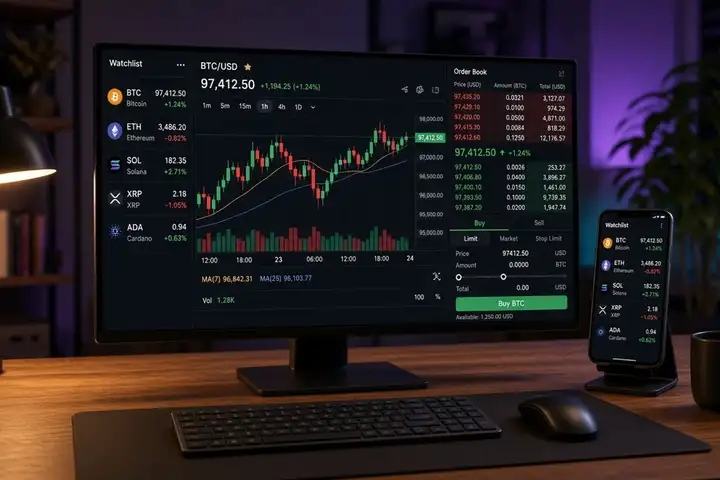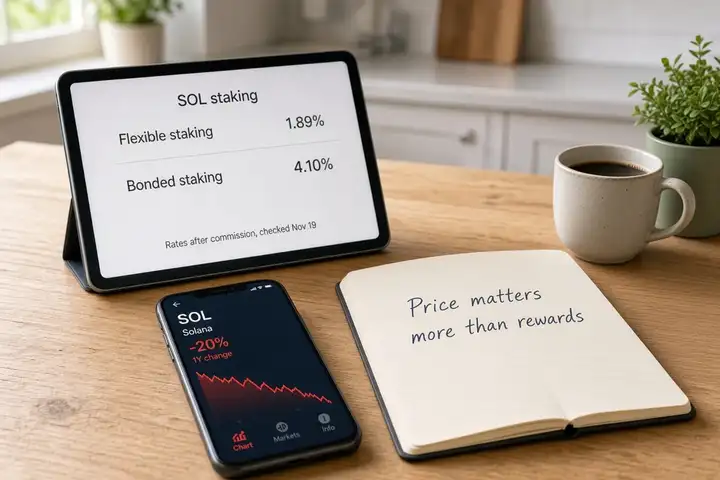
Crypto trading can be profitable for a small minority of traders, but most retail traders lose money. Fees and spreads are charged on every trade, leverage turns ordinary price swings into wiped-out accounts, and the market runs 24 hours a day, seven days a week. The data from central banks and regulators points the same way.
That is not the answer most videos give. A screenshot of one winning trade is easy to post; the full year of trades behind it rarely is. This page looks at the numbers we could find from official sources, works through what costs and leverage do to a small account, and ends with a careful way to learn if you still want to try.
This isn’t financial advice. We do not recommend any coin, exchange, strategy or product, and nothing here is a forecast. Crypto prices can fall a long way and stay down, exchanges can freeze withdrawals or fail, and leveraged trading can lose everything you deposit. Check the rules in your country before you start.
Who makes money trading crypto?
Trading means buying and selling often to profit from price moves, not buying a coin and holding it for years. The people with the best odds are usually on the other side of your trade, or charging you to make it:
- Exchanges and brokers collect a fee or a spread on every trade, win or lose. Our glossary explains what a crypto exchange is and how it is paid.
- Market makers and large firms have faster systems, lower fees and more capital than a person on a phone app.
- Course sellers, signal groups and “copy my trades” channels are paid whether or not their followers profit.
- Some individual traders do make money, often with strict rules, small positions and years of practice. They exist, and they are a minority.
When someone asks whether crypto trading is profitable, the useful question is: profitable for whom, after which costs, and over how long?
Topic hubCrypto trading: Day trading
What the data says about retail traders
There is no official register of every crypto trader’s results. What we do have are studies by central banks and the loss figures regulators collected before they restricted risky products. They are consistent.
Most app users lost money on bitcoin. In a bulletin published on 20 February 2023, the Bank for International Settlements looked at crypto trading app downloads in 95 countries from August 2015 to December 2022. It modelled a user who bought $100 of bitcoin in the month they downloaded an app and every month after. The median investor would have lost $431 by December 2022, almost half of the $900 they had put in, and a majority of investors in nearly all economies in the sample probably lost money (BIS Bulletin No 69, “Crypto shocks and retail losses”). The BIS also found that when prices rose and smaller users were buying, the largest holders were selling to them.
US regulators say the same about day trading in general. The SEC’s long-standing alert Day Trading: Your Dollars at Risk warns that day traders typically suffer severe losses in their first months and that many never become profitable. Investor.gov’s day trading risk page adds that leveraged strategies can lose more than you put in.
Leveraged products lose most accounts. In March 2018 the European Securities and Markets Authority (ESMA) reported that national regulators’ analyses showed 74 to 89 percent of retail accounts typically lose money trading contracts for difference (CFDs), with average losses per client of €1,600 to €29,000 (ESMA press release). Crypto CFDs were capped at 2:1 leverage for retail clients as a result, and EU providers must still show their own loss percentage on every page that advertises CFDs.
The UK banned crypto derivatives for retail customers. The Financial Conduct Authority stopped firms from selling crypto CFDs, futures, options and exchange-traded notes to retail consumers from January 2021, citing extreme volatility, market abuse and consumers’ inability to value these products (FCA policy statement PS20/10).
None of these sources says nobody profits. All of them say the typical outcome for a retail trader is a loss.
Why most beginners lose: costs and the break-even win rate
Every trade has a cost: an exchange fee, a spread between the buy and sell price, or both. On a single trade it looks tiny. Over hundreds of trades it decides the result.
Here is a simple worked example. The 0.2 percent cost per round trip (buy plus sell) is our assumption for illustration, not a quote from any exchange; check your own fee page, because instant-buy fees in apps are often much higher.
| Trading habit | Round trips a year | Left of $1,000 with no edge, costs only |
|---|---|---|
| Once a day | 365 | about $482 |
| Three times a day | 1,095 | about $112 |
“No edge” means your wins and losses would cancel out before costs. Crypto trades every day of the year, so a daily habit adds up faster than in stock markets.
Costs also raise the bar for every strategy. Say you aim to win 2 percent and cut losses at 2 percent. Without costs you break even if you are right half the time. With 0.2 percent per round trip, a win nets 1.8 percent and a loss costs 2.2 percent, so you need to be right 55 percent of the time just to stand still. Most beginners overestimate how often they can do that.
Taxes come on top. In many countries, profits from selling crypto count as capital gains, and frequent trading means more records to keep. Losses do not always offset gains the way people expect. Check your own country’s tax authority before you start.
Leverage: how a small move wipes out an account
Leverage means trading with borrowed money so your position is bigger than your deposit. It is the fastest way crypto traders lose money, because the exchange closes the position (a liquidation) once your deposit is used up.
| Leverage | Price move against you that roughly wipes out the deposit |
|---|---|
| 2x | about 50% |
| 5x | about 20% |
| 10x | about 10% |
| 20x | about 5% |
These are rough figures before fees and funding charges, which make the real threshold a little closer. Exchanges usually liquidate before you reach zero.
Now compare those numbers with how crypto moves. Volatility is normal here: a 10 percent move in a day is not rare for bitcoin and is common for smaller coins. At 10x, one ordinary bad day can end the account. Many futures platforms offer 50x or 100x, which is why regulators in the UK and EU restrict these products for retail customers.
Topic hubCrypto trading: Margin trading
Topic hubCrypto trading: Futures
Is day trading crypto profitable?
Day trading has the worst odds of the common approaches, because it stacks the most trades (and the most costs) on the shortest moves. It also takes hours at a screen, and the market never closes, which makes it easy to overtrade at night or at the weekend.
Swing trading, which holds positions for days or weeks, involves fewer trades and lower total costs, but you are still forecasting direction, and overnight moves can skip past a stop-loss.
Buying and holding is not trading, and it carries its own large risk: the price can fall and stay down for years. It does avoid most of the per-trade costs above. If your goal is long-term growth rather than trading, our guide to how to start investing with little money explains why a broad, low-cost index fund bought at regular intervals (dollar-cost averaging) is the usual starting point, and our crypto beginner’s guide covers holding and staking.
Topic hubCrypto trading: Swing trading
Scams that look like trading
A lot of “crypto trading” losses are not trading losses at all. They are fraud dressed up as a trading platform, a bot or a mentor.
On 19 November 2026 the SEC charged eight entities that allegedly ran fake investment advisers and crypto trading platforms and took more than $37 million from US investors. Victims were recruited through social media ads and group chats, shown stock tips first, then moved to a “platform” where no trading took place. The scheme even used fake SEC certificates to look legitimate.
Warning signs that come up again and again in regulators’ alerts:
- Promises of fixed daily returns. No trading strategy can deliver them. Investor.gov’s crypto scam alert lists this first.
- A mentor or group chat that moves you to a new platform or app. Check any platform against your regulator’s register before you deposit.
- A trading bot that needs your deposit or your wallet’s recovery phrase. Never share a recovery phrase with anyone.
- A balance that grows fast but cannot be withdrawn, or a “tax” or “fee” you must pay before a withdrawal. That is the scam closing.
If you are unsure, stop and ask someone you trust before sending more money.
If you still want to try: a careful way to learn
None of this means you must never place a trade. It means you should find out cheaply whether you have any edge before money you need is involved. Our step-by-step guide to how to trade crypto covers exchanges, order types, position sizing and stop-losses in detail.
- Build the base first. Savings for emergencies and no expensive debt come before trading. Our investing basics hub explains the order.
- Paper-trade first. TradingView’s free plan includes charts and a paper-trading account that uses pretend money. Run your rules there for a few months and subtract realistic fees from every trade.
- Write your rules down. Entry, exit, position size and the most you will lose on one trade. If you change them after every loss, you do not have rules yet.
- Use a small, fixed budget you can lose completely, with no leverage, on a regulated exchange in your country that does proper KYC checks.
- Keep a trade journal, including fees, and judge yourself on a full year of trades, not on your best week.
- Decide in advance when you will stop. For example: if you are down a set amount, or still behind the simple buy-and-hold result after six months.
Partner link: we may earn a commission, at no extra cost to you. Disclosure
If you want structured lessons, Udemy’s Crypto Trading and Investing: Technical Analysis for Bitcoin by Luca Moschini covers chart reading, stop-losses and position sizing. It had a 4.1 rating from 2,836 ratings and was last updated in November 2026 when we read the page on 25 November 2026. Treat it as a way to learn the vocabulary and risk rules, not as a promise that a chart pattern will pay.
If the goal behind your search is simply more money each month, trading is one of the least predictable ways to get it. Our guide to 50 ways to make money online lists options with steadier odds, and the side-hustle income calculator and earnings-per-hour calculator show what a few hours a week could bring in after costs.
Books worth reading
Neither book will make you a profitable trader. They are useful for seeing the odds clearly and for understanding why rules break down under pressure.
A Random Walk Down Wall Street by Burton G. Malkiel makes the long-standing case that most people who try to beat the market fall behind once costs are counted. The 50th anniversary edition adds a chapter on crypto and other speculative fads.
Trading in the Zone by Mark Douglas is about the psychology of trading rather than a strategy: why traders abandon their own rules after a few losses, and why thinking in probabilities matters more than any single trade.
FAQ
Is crypto trading profitable for beginners?
Usually not. Beginners face the same fees as everyone else with less experience, and they are more likely to use leverage or chase sudden moves. Central-bank and regulator data show that most retail traders lose money. Paper-trading first is the cheapest way to find out whether you have any edge.
Can you make money trading crypto?
Some people do, and they are a minority. The ones who last tend to trade small, follow written rules, use little or no leverage and count every fee. Anyone promising a steady daily or monthly return is selling something.
Is day trading crypto profitable?
It has the worst odds of the common approaches. More trades mean more costs, and with 0.2 percent per round trip, a strategy that wins and loses 2 percent needs to be right 55 percent of the time just to break even.
How much do crypto traders make?
There is no reliable average, and income screenshots online are not a fair sample. The best public data, from the BIS and EU regulators, shows a typical retail result below zero. Plan for losing your trading budget, not for an income.
Is crypto trading gambling?
It is not the same, because prices respond to news, supply and demand. For a beginner with no edge, high leverage and short time frames, though, the outcome can behave a lot like gambling: many small costs and the chance of a sudden total loss.
Is it better to trade crypto or to hold it?
Holding avoids most per-trade costs but still carries the risk of a long price fall. Neither is safe. If you want long-term growth, a broad, low-cost fund is the usual starting point, and any crypto should be a small share you could lose entirely.
Sources
- Cornelli, Doerr, Frost and Gambacorta, “Crypto shocks and retail losses,” BIS Bulletin No 69, Bank for International Settlements, 20 February 2023, bis.org.
- ESMA, “ESMA agrees to prohibit binary options and restrict CFDs to protect retail investors,” press release ESMA71-98-128, 27 March 2018, esma.europa.eu.
- Financial Conduct Authority, PS20/10, “Prohibiting the sale to retail clients of investment products that reference cryptoassets,” October 2020, fca.org.uk.
- U.S. Securities and Exchange Commission, “Day Trading: Your Dollars at Risk,” sec.gov; Investor.gov, “Thinking of Day Trading? Know the Risks,” investor.gov.
- U.S. Securities and Exchange Commission, press release 2026-115, 19 November 2026, sec.gov.
- Investor.gov, “Digital Asset and ‘Crypto’ Investment Scams: Investor Alert,” investor.gov.