You earn money in Web3 without investing by getting paid for ordinary work: writing, design, support, community or development, in cash or a stablecoin you can cash out, not by buying a coin and hoping the price rises. The useful test is simple: would you still be paid if the project’s token went to zero?
A lot of advice still starts the other way around. Buy the token, farm the points, flip the NFT, join a play-to-earn game that wants a character fee up front. That is speculation, and our Web3 hub is honest about how much of it was left after the last boom. The quieter path is the one that already works in every other industry, and in most of the entries in our guide to 50 ways to make money online: someone has a job that needs doing, and they pay you for doing it.
This guide is about that path. It covers what “without investing” actually means, which kinds of work still get paid, how to find it, how to get paid in money you can use, and the scams that dress themselves up as a first Web3 job.
This isn’t financial advice. We do not recommend any coin, project, platform or job board. Crypto prices can fall a long way, tokens used as wages can become unsellable, and you can lose money you are owed if a project disappears. Check the rules where you live before you start.
What “without investing” actually means
It means you are selling your time and skill, not buying an asset. You invoice for work, you get paid, and you can use that money for rent. You do not have to buy a project’s token to access the role, stake coins to qualify, or pay a fee for a character, a land plot or a course that promises a job at the end.
Two lines get blurry, and both are still investing in disguise:
- Being paid only in the project’s own token. If you cannot readily sell it for cash, or the price is the whole reason the wage looks generous, you are taking market risk for work you have already done. Our Web3 hub puts it plainly: invoice in a currency you can pay rent with.
- Airdrops, points and “learn and earn” quizzes. These can pay a little, they can be taxable when you receive them, and fake ones are a standard way to drain a wallet. Treat them as optional and usually tiny, not as a plan.
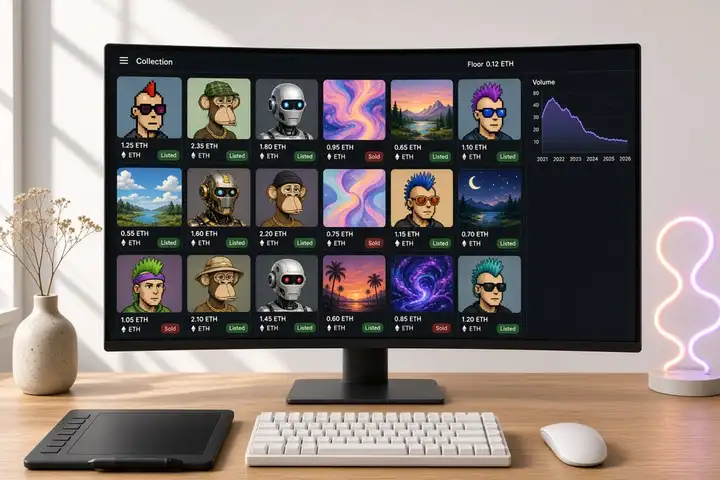
Play-to-earn games and NFT flipping belong on the other side of that line. If you want the picture of what is left there, start with whether NFTs are dead in 2026 and the Web3 hub. If you are curious about buying and holding crypto itself, start with our beginner’s guide to crypto.
The work that still pays
Topic hubWeb3 & NFTs: Services that are still just freelancing
Most paid Web3 work is a familiar job with a blockchain client list. You do not need to be a protocol engineer to get started, and you should not expect a hiring boom just because a project uses the word Web3.
The builder market itself is smaller than the hype implied. In the 28 days to 30 September 2026, 29,882 developers committed code to public crypto projects, 3.4 percent fewer than the previous quarter and 25.8 percent fewer than a year earlier, according to CryptoKeyhole’s reading of Open Dev Data, the public dataset compiled by Electric Capital and last updated on 25 November 2026 (CryptoKeyhole; Open Dev Data). That is a fact about people writing code, not about every role, but it is a useful correction: you are competing for a limited number of paid seats, not walking into a gold rush.
The work that shows up again and again:
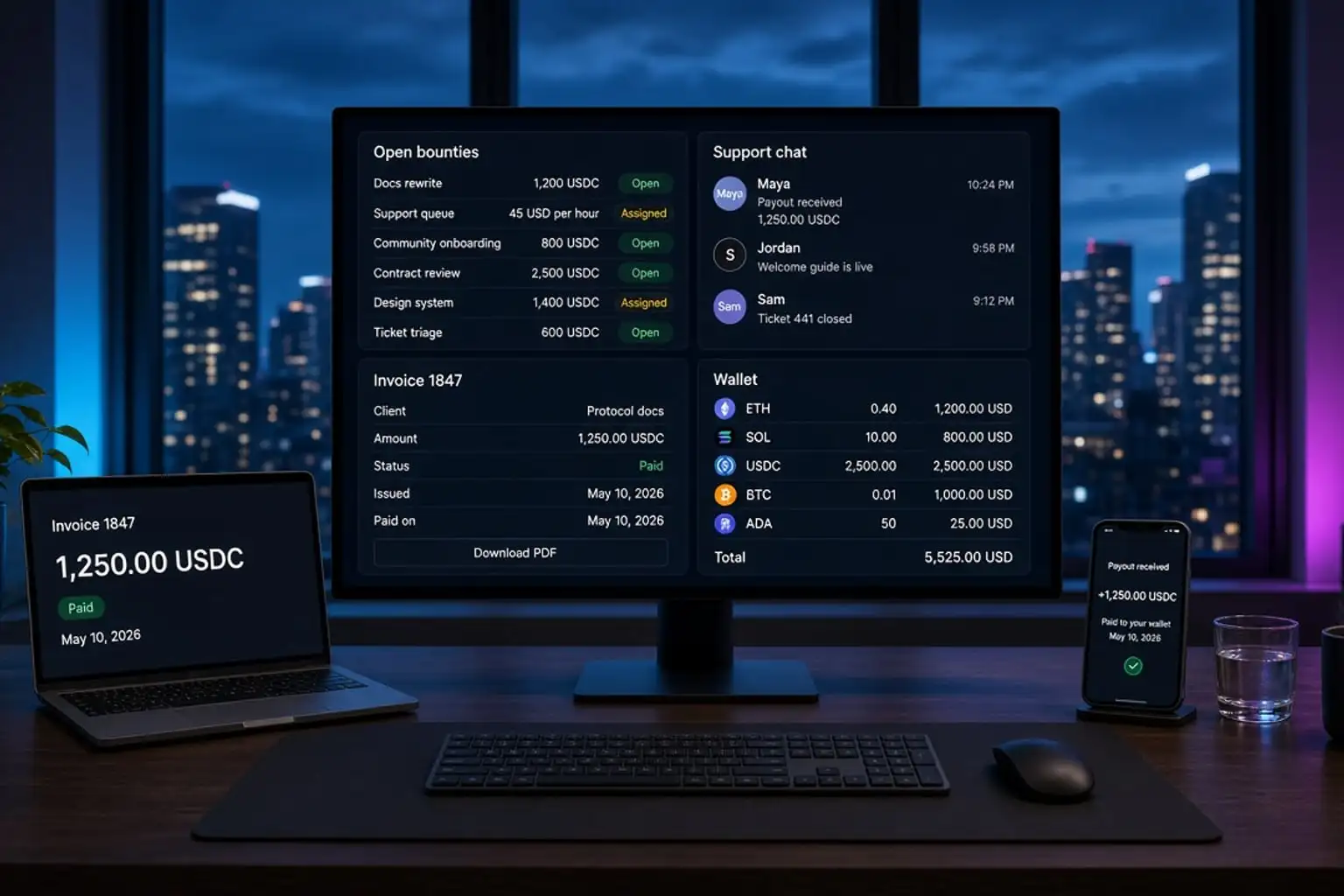
- Writing and documentation. Help pages, release notes, tutorials, grant applications and explainers for users who are not engineers. If you already write clearly, this is the most common beginner door.
- Design. Interface work, brand kits, presentation decks and the occasional 3D asset for an event or a game. The client is a crypto project; the craft is the same as any other product design job.
- Support and community. Answering users, running a moderation queue, writing onboarding guides, hosting office hours. “Community manager” is the title you will see most often, and it is shift work, not a lifestyle brand.
- Operations, compliance and research. Onboarding, payments ops, KYC support, vendor coordination, or gathering sources for a weekly brief. These sit closer to ordinary office work than to trading.
- Development and security. Smart-contract work, wallet features, audits and reviews. This is the best paid and the least beginner-friendly. It needs a portfolio of shipped code, not a weekend tutorial.
None of these is a passive income stream. They are jobs and contracts. Price them the way you would price any freelance work, after unpaid admin and tax, which is what our earnings-per-hour calculator and side-hustle income calculator are for.
How to find the work
Start with a short, public sample of work a stranger can judge: a documentation rewrite, a support guide, a design case, a script or a small tool. Then look in the places actual teams already use.
- The project’s own careers page and official accounts, not a stranger in a group chat.
- Freelance platforms and specialist job boards that list writing, design, support and engineering roles. Read each listing as you would any other job: who the company is, how they pay, and whether they ask you to pay them first.
- Bounties for a defined task with a published budget, on a board the project itself points to. A bounty in a direct message, or one that starts with “connect your wallet to apply,” is not a bounty.
A few rules that save people a lot of grief:
- Never pay to apply, to reach a recruiter, or to receive equipment.
- Do not connect a wallet, share a recovery phrase, or install a “test” app as part of an interview.
- Be wary of a role that requires you to buy the project’s token, or to recruit others, before you have done any paid work.
- If the only brief is “we will pay you in exposure and tokens at launch,” it is not a job.
Our freelancing hub covers pitching, contracts and pricing if you have not invoiced a client before. The Web3 part is mostly a different client list, not a different profession.
Get paid in cash or stablecoins, not the project’s token
Agree the currency, the amount, the due date and the payment method in writing before you start. The clean options are a bank transfer, or a widely used dollar stablecoin such as USDC, paid to an address you control or through a platform that already handles payouts.
If a project will only pay in its own token, treat that as a decline, or as a small bonus on top of a cash fee, not as the wage. Tokens can be hard to sell, can fall before you get around to selling, and can carry their own tax paperwork.
When you do receive a stablecoin, cash it out through an exchange that is allowed to serve customers where you live, and complete its identity checks. You do not need a long list of brand names to do that; you need a firm you can actually use and withdraw from. For the general risks of holding coins on a platform, see the cryptocurrency hub.
Tax, invoices and records
Paid work is income, whether it arrives in dollars, in a stablecoin or in some other token.
In the US, the IRS treats digital assets as property, and crypto you receive in exchange for goods or services is ordinary income, valued in dollars at the fair market value when you receive it (IRS, digital assets). Keep the invoice, the payment record and that dollar value. US payers may also send a Form 1099; you still owe tax on the income if they do not. Starting with 2025 transactions, custodial brokers report sales on Form 1099-DA, which is separate from income for work.
In the UK, HMRC treats crypto you receive for work as income, and later sales can also fall under Capital Gains Tax (HMRC, receiving cryptoassets). The self-employed report this through Self Assessment.
In the EU and elsewhere, income tax usually applies when you are paid, with local rules on VAT and on later sales. Check your own tax authority, or ask a qualified adviser, before you file.
Send an invoice for every job, keep a simple log of dates, amounts and the dollar value, and do not spend the tax portion. The paperwork is the unglamorous half of getting paid.
Scams that look like work
Fake jobs follow crypto money because people are already primed to connect a wallet. Watch for:
- Recruiters who message you first with a too-clean offer, then move you off the official channel to a new site or a “HR wallet.”
- “Trial tasks” or “assessment dApps” that ask you to connect a wallet, sign a transaction or share a recovery phrase.
- Unpaid tests that are the actual job, such as writing a full article or delivering a finished design with no contract and no fee.
- Pay-to-work schemes, including equipment you must buy, training you must purchase, or a token you must hold before the first paycheck.
- Recovery or visa services that promise to get you a remote crypto job, or to recover unpaid wages, for an upfront fee.
If a step would look absurd in a normal hiring process (paying the employer, signing a mystery transaction, or keeping the work secret from the official company channel), stop. The patterns overlap with the ones we describe in which money apps are legit and in the crypto guide’s scam section.
If Web3 work is not for you
That is a reasonable conclusion. The same skills sell to clients who pay in ordinary currency and never mention a chain. Our 50 ways to make money online guide lists options with their catches, and the freelancing and digital products hubs go deeper on work that does not depend on a token price.
If your interest was really in buying coins, not in doing work, be clear with yourself about that, and read the crypto beginner’s guide and whether crypto trading is profitable before you put money in.
Books and a course
You do not need a Web3 course to invoice a documentation job. These two books help with the work around the work: staying small, and being findable.
Company of One by Paul Jarvis is about running a one-person business on purpose: finding clients, setting prices and refusing growth you do not want. The client can be a bakery or a protocol; the discipline is the same.
Partner link: we may earn a commission, at no extra cost to you. Disclosure
Show Your Work! by Austin Kleon is a short book on sharing what you are making as you make it, so the right people can find you. That matters more than a keyword-stuffed “Web3 expert” headline if you are still building a body of work.
If you want structured lessons on the freelance side, Udemy’s How to Build a Successful Freelance Business by Maggie Stara covers finding clients, pricing and contracts. Use it for the business habits, not as a promise that Web3 clients will appear on their own.
FAQ
How can I earn money in Web3 without investing?
Get paid for work, in cash or a stablecoin you can cash out. Writing, design, support, community and development are the usual paid roles. Do not buy a project’s token to qualify, and do not accept that token as your only wage.
Do I need to be a developer to get a Web3 job?
No. Documentation, design, support and community roles are hired regularly and do not require writing smart contracts. Engineering and security jobs pay more and expect a portfolio of shipped code.
Are airdrops and play-to-earn a way to get paid without investing?
Usually not. Play-to-earn often requires an upfront purchase, and airdrops are irregular, often small, sometimes taxable and frequently used as bait for scams. They are not a substitute for invoiced work.
How should I get paid?
Agree a cash or stablecoin fee in writing before you start, send an invoice, and cash out through a service that is allowed to serve you where you live. If the only offer is the project’s own token, you are taking market risk on work you have already done.
Do I pay tax if I am paid in crypto?
In the US, yes: the IRS treats crypto received for work as ordinary income at its dollar value when you receive it. The UK and most other countries also tax that income. Keep records and check your own tax authority’s rules.
Sources
- CryptoKeyhole, “Crypto Developer Report: Ecosystems Quarter by Quarter,” last updated 25 November 2026, 15:40 UTC, a reading of Open Dev Data by Electric Capital, cryptokeyhole.com.
- Electric Capital, Open Dev Data, opendevdata.org.
- IRS, “Digital assets,” irs.gov.
- HMRC, “Check if you need to pay tax when you receive cryptoassets,” gov.uk.